



Date of planning:…………..
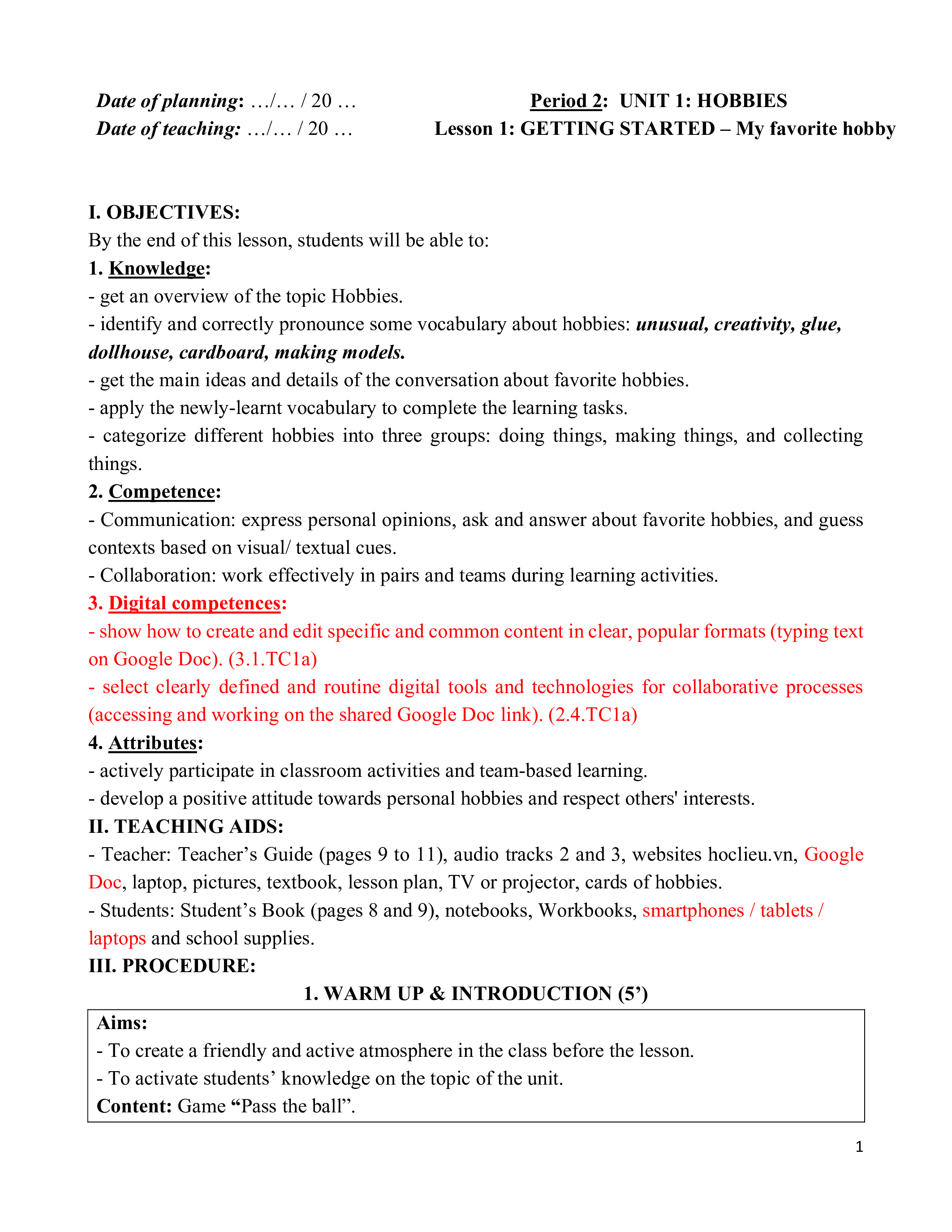
Period ..... : REVIEW 1 (UNIT 1-2-3)
Date of teaching: ………..…
Lesson 1: LANGUAGE / Pronunciation- WEEK: … Vocabulary-Grammar
I. OBJECTIVES: By the end of this review, Ss will have revised the language they have learnt
and the skills they have practised in Units 1 -3.
1. Knowledge: - To revise the language and skills they have learnt in Unit 1-2-3.
- Revise the words related to hobbies and verbs of liking and disliking; healthy activities and health
problems; and words related to community activities;
- Pronounce the sounds /ə/, /ɜ:/, /f/, /v/, /t/, /d/, /ɪd/ correctly in isolation and in context;
- Revise the present simple tense, past simple to talk about past activities;
- Revise how to ask for and give health tips; how to give compliments.
a) Vocabulary: Ss revise the words related to hobbies and verbs of liking and disliking; healthy
activities and health problems; and words related to community activities;
b) Grammar : Revise the present simple tense, past simple to talk about past activities; Simple sentences.
c) Writing : - Writing a paragraph about your hobby; Writing a passage to give advice on how to
avoid viruses; Writing an email about school activities last summer.
2. Competence: Develop communication skills and cultural awareness
- Develop communication skills and creativity.
- Be cooperative and supportive in pair work and teamwork.
- Actively join in class activities
3. Qualities : - Raise students’ awareness of the need to keep their neighbourhood green.
- Have the good attitude to working in groups, individual work, pair work, cooperative learning. - Develop self-study skills. II. TEACHING AIDS:
- Teacher: Grade 7 text book, laptop, projector / TV/ pictures and cards.....
- Students : Text books, studying equipment….
- Computer connected to the Internet. - Sach mem.vn III. PROCEDURE:
Notes: In each activity, each step will be represented as following: * Deliver the task. * Implement the task. * Discuss. * Give comments or feedback.
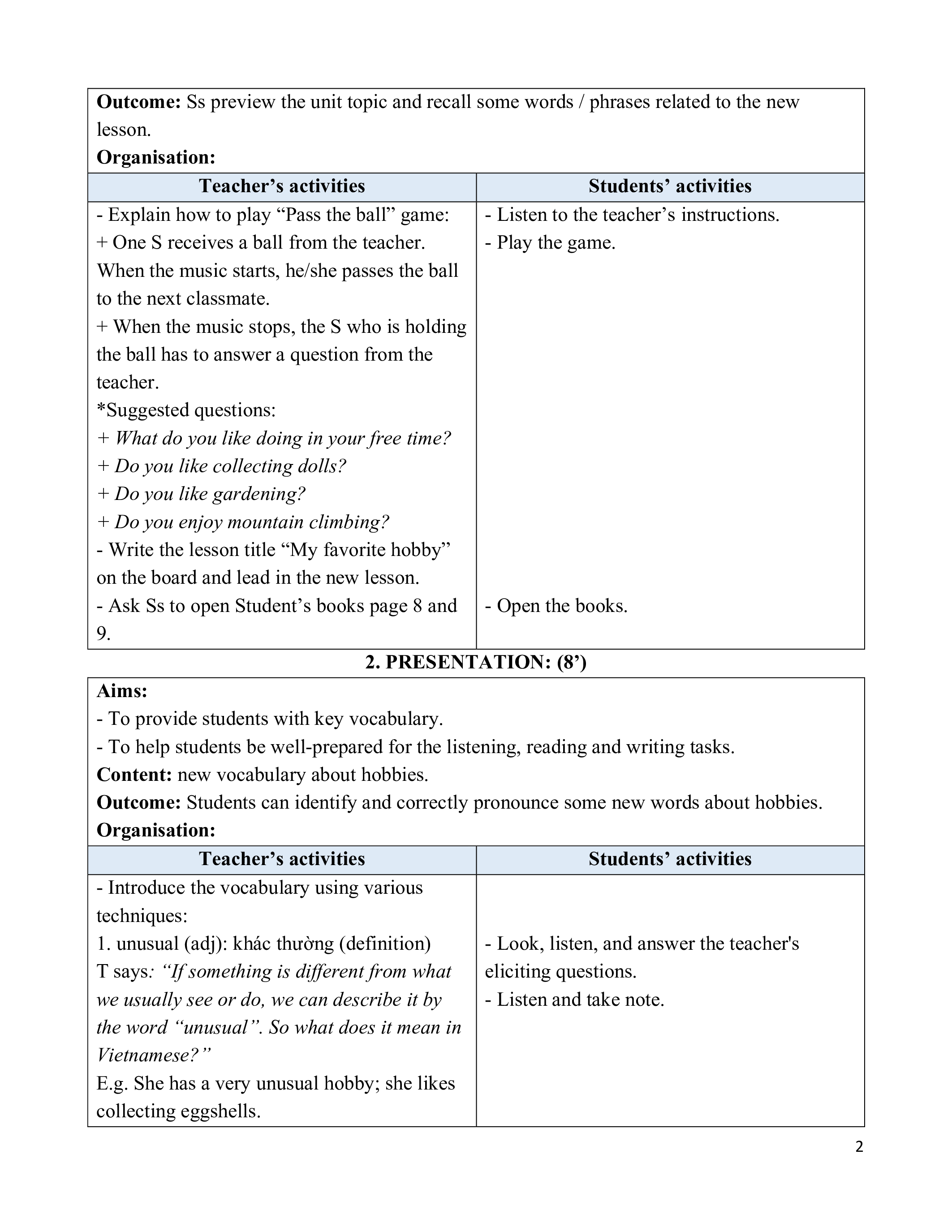
1. WARM UP & INTRODUCTION (5’) Aim: Introduction
- By the end of this review, students will have revised the language they have learnt and the skills
they have practised in Units 1 – 3.
- Ss revise what they have learnt so far in terms of language and skills.
- Summarise their answers in notes and write them in a top corner of the board. Briefly revise some
important / difficult ones before starting the review.
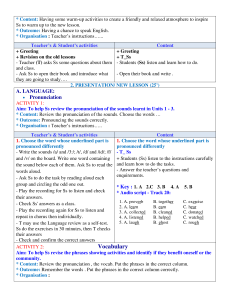
* Content: Having some warm-up activities to create a friendly and relaxed atmosphere to inspire
Ss to warm up to the new lesson.
* Outcome: Having a chance to speak English.
* Organisation : Teacher’s instructions…...
Teacher’s & Student’s activities Content + Greeting + Greeting
+ Revision on the old lessons + T_Ss
- Teacher (T) asks Ss some questions about them - Students (Ss) listen and learn how to do. and class.
- Ask Ss to open their book and introduce what - Open their book and write . they are going to study….
2. PRESENTATION/ NEW LESSON (25’) A. LANGUAGE: • Pronunciation ACTIVITY 1:
Aim: To help Ss review the pronunciation of the sounds learnt in Units 1 - 3.
* Content: Review the pronunciation of the sounds. Choose the words …
* Outcome: Pronouncing the sounds correctly.
* Organisation : Teacher’s instructions…..
Teacher’s & Student’s activities Content
1. Choose the word whose underlined part is
1. Choose the word whose underlined part is pronounced differently pronounced differently
- Write the sounds /a/ and /3:/; /t/, /d/ and /id/; /f/ - T_ Ss
and /v/ on the board. Write one word containing
+ Students (Ss) listen to the instructions carefully
the sound below each of them. Ask Ss to read the and learn how to do the tasks. words aloud.
- Answer the teacher’s questions and enquirements.
- Ask Ss to do the task by reading aloud each
group and circling the odd one out.
* Key : 1. A 2.C 3. B 4. A 5. B
- Play the recording for Ss to listen and check
* Audio script - Track 20: their answers.
- Check Ss' answers as a class. 1. A. proverb B. together C. exercise 2. A. learn B. earn C. hear
- Play the recording again for Ss to listen and 3. A. collected B. cleaned C. donated
repeat in chorus then individually. 4. A. listened B. helped C. watched
- T may use the Language review as a self-test. 5. A. laugh B. ghost C. rough
Ss do the exercises in 30 minutes, then T checks their answers
- Check and confirm the correct answers ACTIVITY 2: Vocabulary
Aim: To help Ss revise the phrases showing activities and identify if they benefit oneself or the community.
* Content: Review the pronunciation , the vocab. Put the phrases in the correct column.
* Outcome: Remember the words . Put the phrases in the correct column correctly. * Organisation :
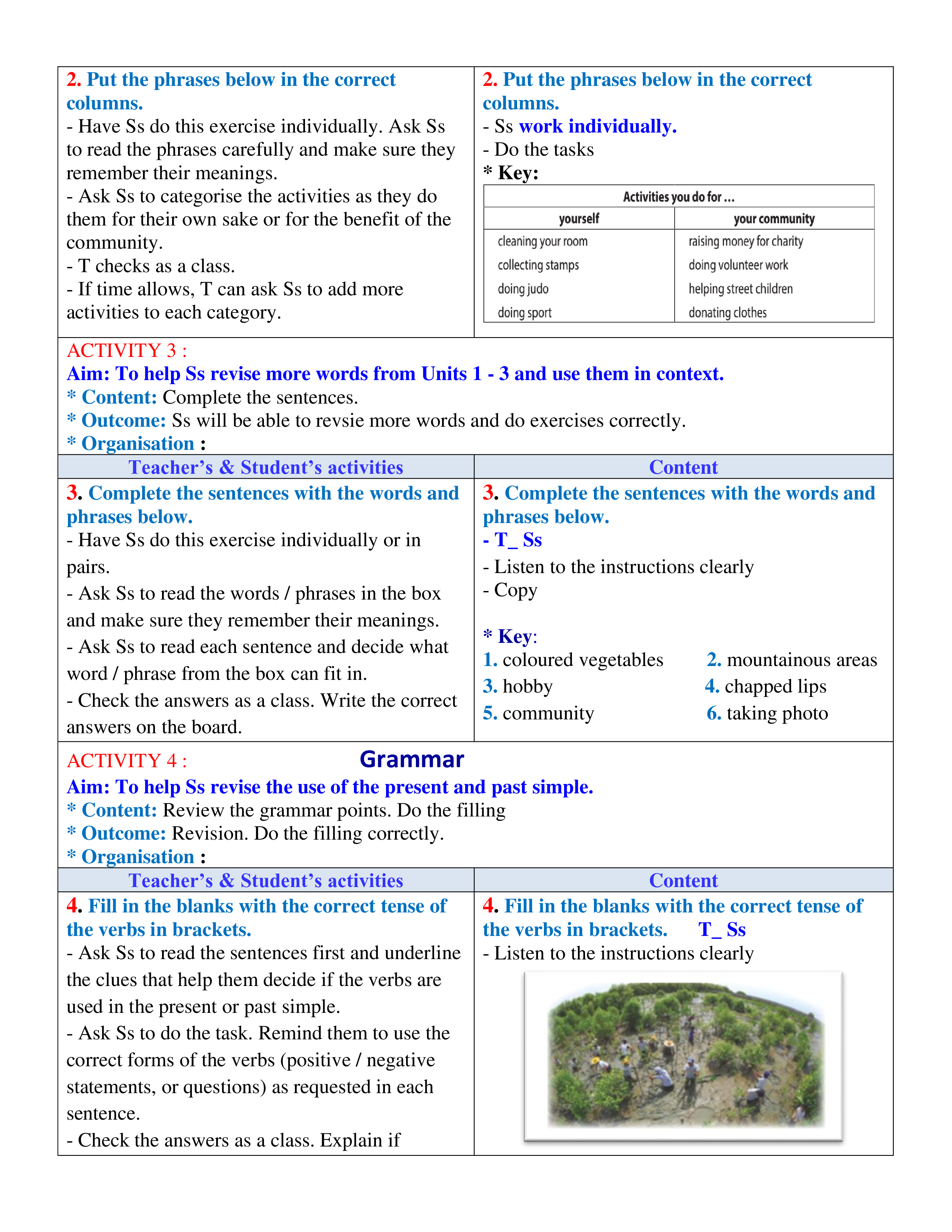
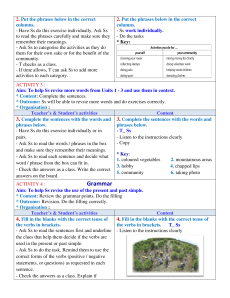
2. Put the phrases below in the correct
2. Put the phrases below in the correct columns. columns.
- Have Ss do this exercise individually. Ask Ss
- Ss work individually.
to read the phrases carefully and make sure they - Do the tasks remember their meanings. * Key:
- Ask Ss to categorise the activities as they do
them for their own sake or for the benefit of the community. - T checks as a class.
- If time allows, T can ask Ss to add more activities to each category. ACTIVITY 3 :
Aim: To help Ss revise more words from Units 1 - 3 and use them in context.
* Content: Complete the sentences.
* Outcome: Ss will be able to revsie more words and do exercises correctly. * Organisation :
Teacher’s & Student’s activities Content
3. Complete the sentences with the words and 3. Complete the sentences with the words and phrases below. phrases below.
- Have Ss do this exercise individually or in - T_ Ss pairs.
- Listen to the instructions clearly
- Ask Ss to read the words / phrases in the box - Copy
and make sure they remember their meanings. * Key:
- Ask Ss to read each sentence and decide what 1. coloured vegetables 2. mountainous areas
word / phrase from the box can fit in.
3. hobby 4. chapped lips
- Check the answers as a class. Write the correct 5. community 6. taking photo answers on the board. ACTIVITY 4 : Grammar
Aim: To help Ss revise the use of the present and past simple.
* Content: Review the grammar points. Do the filling
* Outcome: Revision. Do the filling correctly. * Organisation :
Teacher’s & Student’s activities Content
4. Fill in the blanks with the correct tense of
4. Fill in the blanks with the correct tense of the verbs in brackets.
the verbs in brackets. T_ Ss
- Ask Ss to read the sentences first and underline - Listen to the instructions clearly
the clues that help them decide if the verbs are
used in the present or past simple.
- Ask Ss to do the task. Remind them to use the
correct forms of the verbs (positive / negative
statements, or questions) as requested in each sentence.
- Check the answers as a class. Explain if
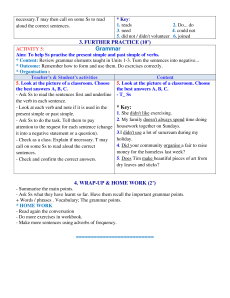
necessary.T may then call on some Ss to read * Key: aloud the correct sentences. 1. reads 2. Do... do
3. need 4. could not
5. did not / didn't volunteer 6. joined
3. FURTHER PRACTICE (10’) ACTIVITY 5: Grammar
Aim: To help Ss practise the present simple and past simple of verbs.
* Content: Review grammar elements taught in Units 1-3. Turn the sentences into negative...
* Outcome: Remember how to form and use them. Do exercises correctly. * Organisation :
Teacher’s & Student’s activities Content
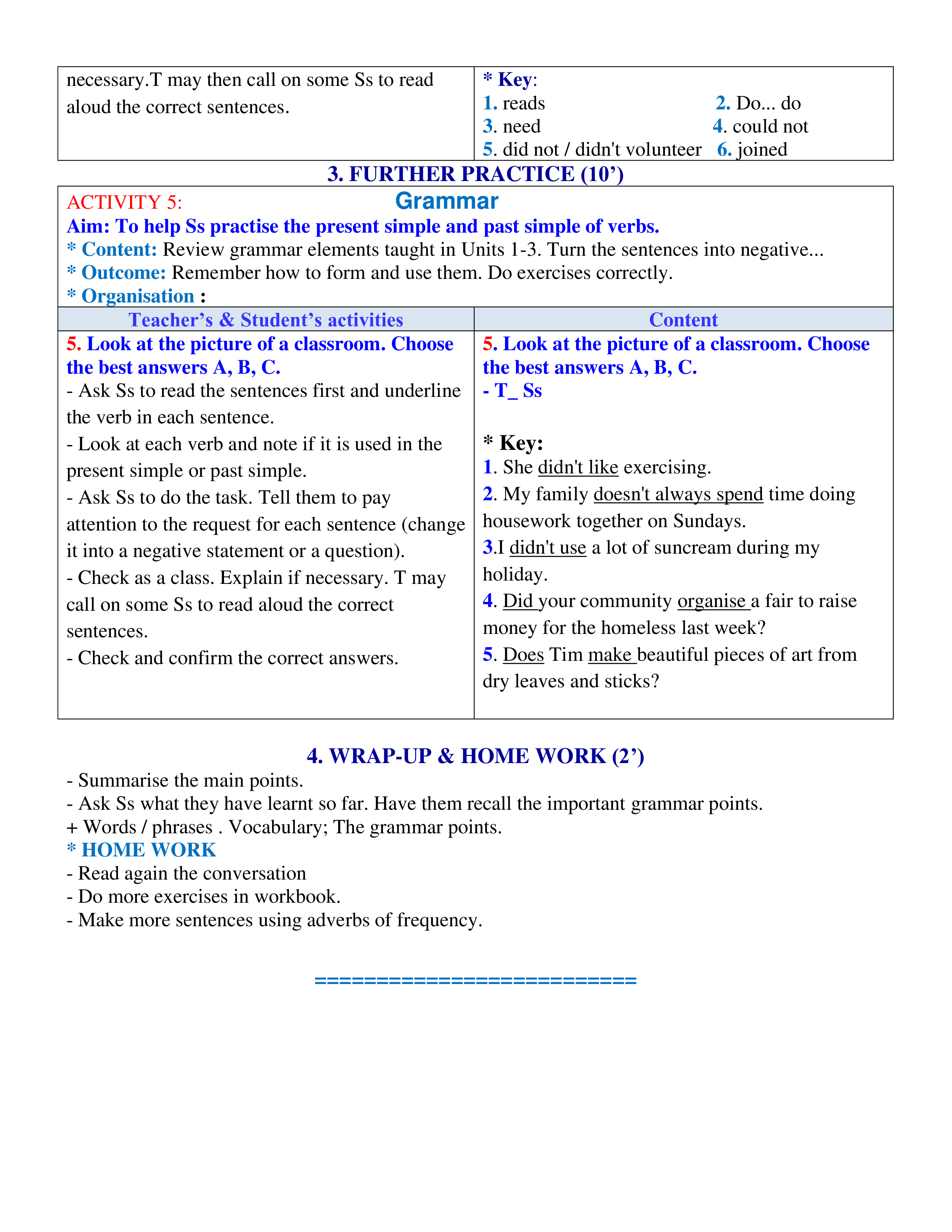
5. Look at the picture of a classroom. Choose
5. Look at the picture of a classroom. Choose
the best answers A, B, C.
the best answers A, B, C.
- Ask Ss to read the sentences first and underline - T_ Ss
the verb in each sentence.
- Look at each verb and note if it is used in the * Key:
present simple or past simple.
1. She didn't like exercising.
- Ask Ss to do the task. Tell them to pay
2. My family doesn't always spend time doing
attention to the request for each sentence (change housework together on Sundays.
it into a negative statement or a question).
3.I didn't use a lot of suncream during my
- Check as a class. Explain if necessary. T may holiday.
call on some Ss to read aloud the correct
4. Did your community organise a fair to raise sentences.
money for the homeless last week?
- Check and confirm the correct answers.
5. Does Tim make beautiful pieces of art from dry leaves and sticks?
4. WRAP-UP & HOME WORK (2’) - Summarise the main points.
- Ask Ss what they have learnt so far. Have them recall the important grammar points.
+ Words / phrases . Vocabulary; The grammar points. * HOME WORK
- Read again the conversation
- Do more exercises in workbook.
- Make more sentences using adverbs of frequency.
==========================

Giáo án Tiếng Anh 7 Global success (năng lực số)
22.9 K
11.5 K lượt tải
200.000 ₫
-
250.000 ₫
MUA NGAY ĐỂ XEM TOÀN BỘ TÀI LIỆU
CÁCH MUA:
- B1: Gửi phí vào TK:
1133836868- CT TNHH DAU TU VA DV GD VIETJACK - Ngân hàng MB (QR) - B2: Nhắn tin tới Zalo VietJack Official ( nhấn vào đây ) để xác nhận thanh toán và tải tài liệu - giáo án
Liên hệ ngay Hotline hỗ trợ: 084 283 45 85
Bộ giáo án Tiếng anh 7 (Năng lực số) - Tiến độ cập nhật (đến Review 2).
Bộ giáo án Tiếng anh 7 (không tích hợp NLS) - Tiến độ cập nhật Full.
Để tải tài liệu gốc về máy bạn click vào nút Tải Xuống ở trên!
- Bộ giáo án Tiếng anh 7 Global success tích hợp năng lực số mới, chuẩn nhất được thiết kế theo phong cách hiện đại, đẹp mắt, trình bày chi tiết cho từng bài học và bám sát chương trình Sách giáo khoa Tiếng anh 7.
- Kế hoạch bài dạy Tiếng anh 7 gồm: 12 Unit; 4 bài Review.
- Phiên bản 1: Tích hợp NLS - Giá: 250.000 đồng
- Phiên bản 2: Không tích hợp NLS - Giá: 200.000 đồng
Đánh giá
4.6 / 5(22926 )5
4
3
2
1

Trọng Bình
Tài liệu hay
Giúp ích cho tôi rất nhiều
Duy Trần
Tài liệu chuẩn
Rất thích tài liệu bên VJ soạn (bám sát chương trình dạy)
TÀI LIỆU BỘ BÁN CHẠY MÔN Tiếng Anh
Xem thêm-
 Bài giảng Powerpoint Tiếng Anh 7 Global success250.000 ₫ 6 K 3 K lượt tải
-
 Bộ 26 đề thi giữa kì 1 Tiếng Anh 7 Global success có đáp án200.000 ₫ 62.7 K 31.4 K lượt tải
-
Giáo án Tiếng Anh 7 Global success (năng lực số)200.000 ₫ - 250.000 ₫ 22.8 K 11.4 K lượt tải
-
Đề luyện thi HSG Tiếng Anh 7 | Đề thi học sinh giỏi Anh 7300.000 ₫ 39.1 K 19.6 K lượt tải
-
Đề cương ôn tập Giữa kì 1 Tiếng Anh 7 Global Success80.000 ₫ 2 K 1 K lượt tải
-
Bộ trắc nghiệm Tiếng Anh 7 Global Success có đáp án150.000 ₫ 16.5 K 8.2 K lượt tải
-
Bài tập Tiếng Anh 7 Global success (cả năm) có đáp án200.000 ₫ 7 K 3.5 K lượt tải
-
Bộ 10 đề thi cuối kì 1 Tiếng Anh 7 Global success có đáp án150.000 ₫ 21.2 K 10.6 K lượt tải
TÀI LIỆU BỘ BÁN CHẠY Lớp 7
Xem thêm-
Bộ 57 đề thi giữa kì 1 Toán 7 Kết nối tri thức Cấu trúc mới150.000 ₫ - 200.000 ₫ 85.9 K 42.9 K lượt tải
-
Bộ đề thi Giữa kì 1 Lịch sử 7 Kết nối tri thức Cấu trúc mới70.000 ₫ 3 K 1.5 K lượt tải
-
Đề cương ôn tập Giữa kì 1 Toán 7 Kết nối tri thức cấu trúc mới80.000 ₫ 14.8 K 7.4 K lượt tải
-
Bài giảng Powerpoint Địa lí 7 Kết nối tri thức250.000 ₫ 8.3 K 4.1 K lượt tải
-
Bộ 20 đề thi giữa kì 1 Ngữ Văn 7 Kết nối tri thức Cấu trúc mới có đáp án150.000 ₫ 33.9 K 16.9 K lượt tải
-
Bài giảng Powerpoint Ngữ văn 7 Kết nối tri thức350.000 ₫ 15.5 K 7.8 K lượt tải
-
Bài tập ôn tập + Đề kiểm tra Toán 7 Kết nối tri thức theo chương250.000 ₫ 3.7 K 1.9 K lượt tải
-
Giáo án HĐTN 7 Kết nối tri thức (năng lực số)200.000 ₫ - 250.000 ₫ 14.4 K 7.2 K lượt tải

 Nhắn tin Zalo