





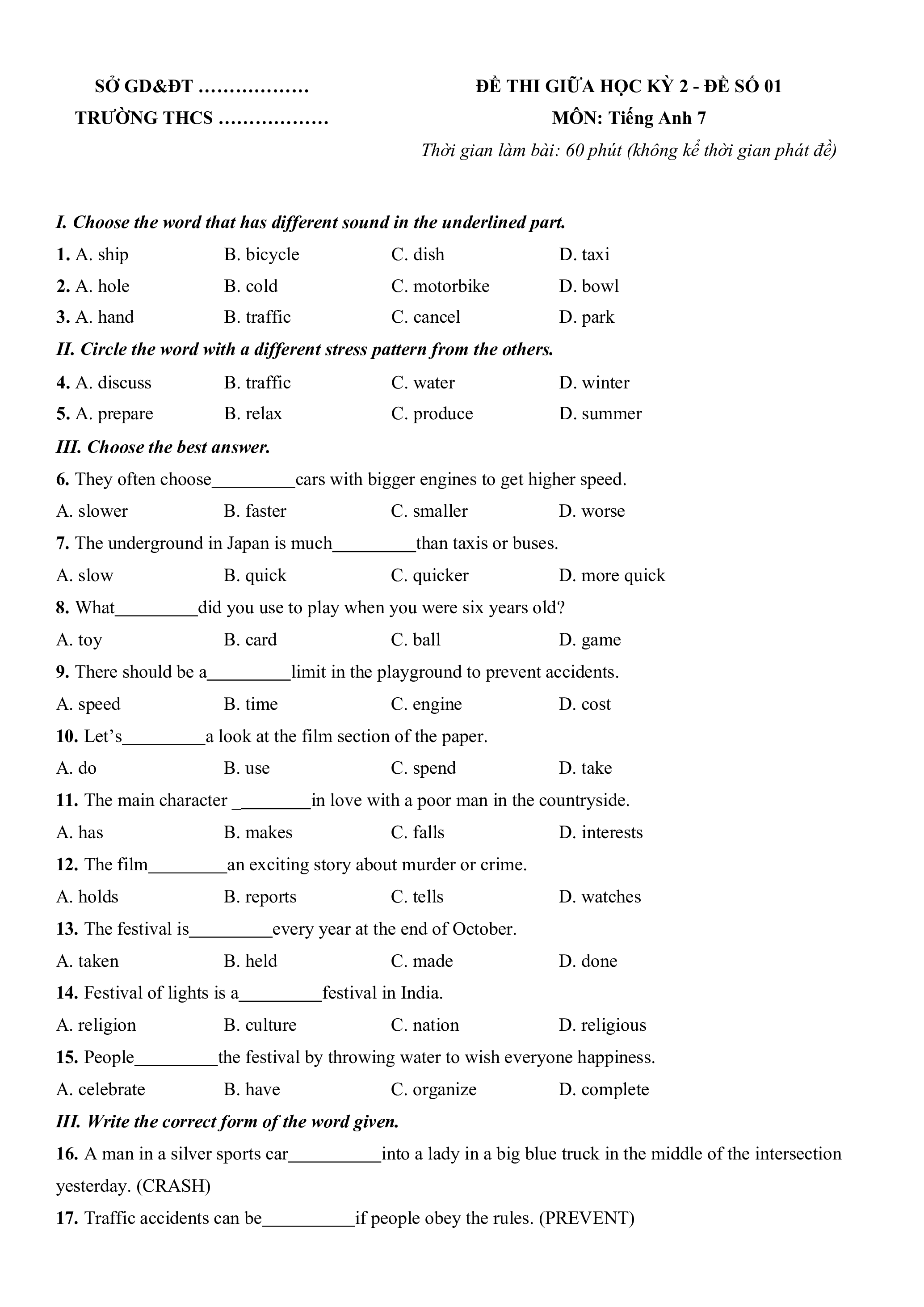
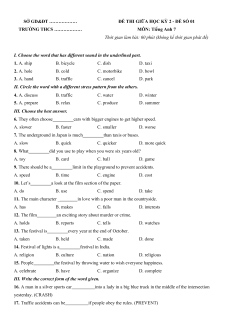
SỞ GD&ĐT ………………
ĐỀ THI GIỮA HỌC KỲ 2 - ĐỀ SỐ 01
TRƯỜNG THCS ……………… MÔN: Tiếng Anh 7
Thời gian làm bài: 60 phút (không kể thời gian phát đề)
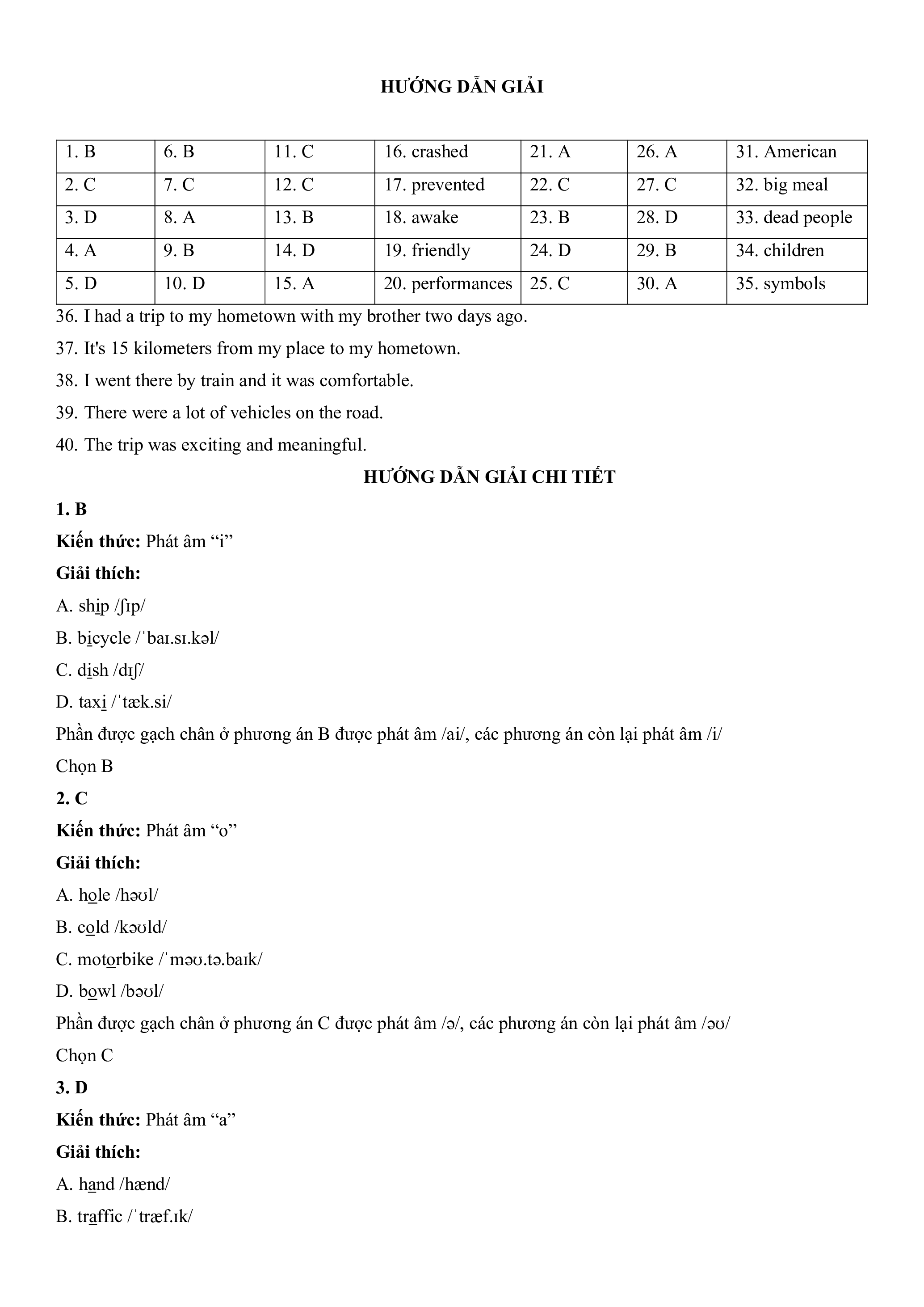
I. Choose the word that has different sound in the underlined part. 1. A. ship B. bicycle C. dish D. taxi 2. A. hole B. cold C. motorbike D. bowl 3. A. hand B. traffic C. cancel D. park
II. Circle the word with a different stress pattern from the others. 4. A. discuss B. traffic C. water D. winter 5. A. prepare B. relax C. produce D. summer
III. Choose the best answer. 6. They often choose
cars with bigger engines to get higher speed. A. slower B. faster C. smaller D. worse
7. The underground in Japan is much than taxis or buses. A. slow B. quick C. quicker D. more quick 8. What
did you use to play when you were six years old? A. toy B. card C. ball D. game 9. There should be a
limit in the playground to prevent accidents. A. speed B. time C. engine D. cost 10. Let’s
a look at the film section of the paper. A. do B. use C. spend D. take
11. The main character _
in love with a poor man in the countryside. A. has B. makes C. falls D. interests 12. The film
an exciting story about murder or crime. A. holds B. reports C. tells D. watches 13. The festival is
every year at the end of October. A. taken B. held C. made D. done
14. Festival of lights is a festival in India. A. religion B. culture C. nation D. religious 15. People
the festival by throwing water to wish everyone happiness. A. celebrate B. have C. organize D. complete
III. Write the correct form of the word given.
16. A man in a silver sports car
into a lady in a big blue truck in the middle of the intersection yesterday. (CRASH)
17. Traffic accidents can be
if people obey the rules. (PREVENT) 18. He was still
when I saw him at 11 o’clock yesterday evening. (WAKE) 19. A crazy cat and a
dog help him to find his parents. (FRIEND) 20. How many
_ are there in the program tonight? (PERFORM)
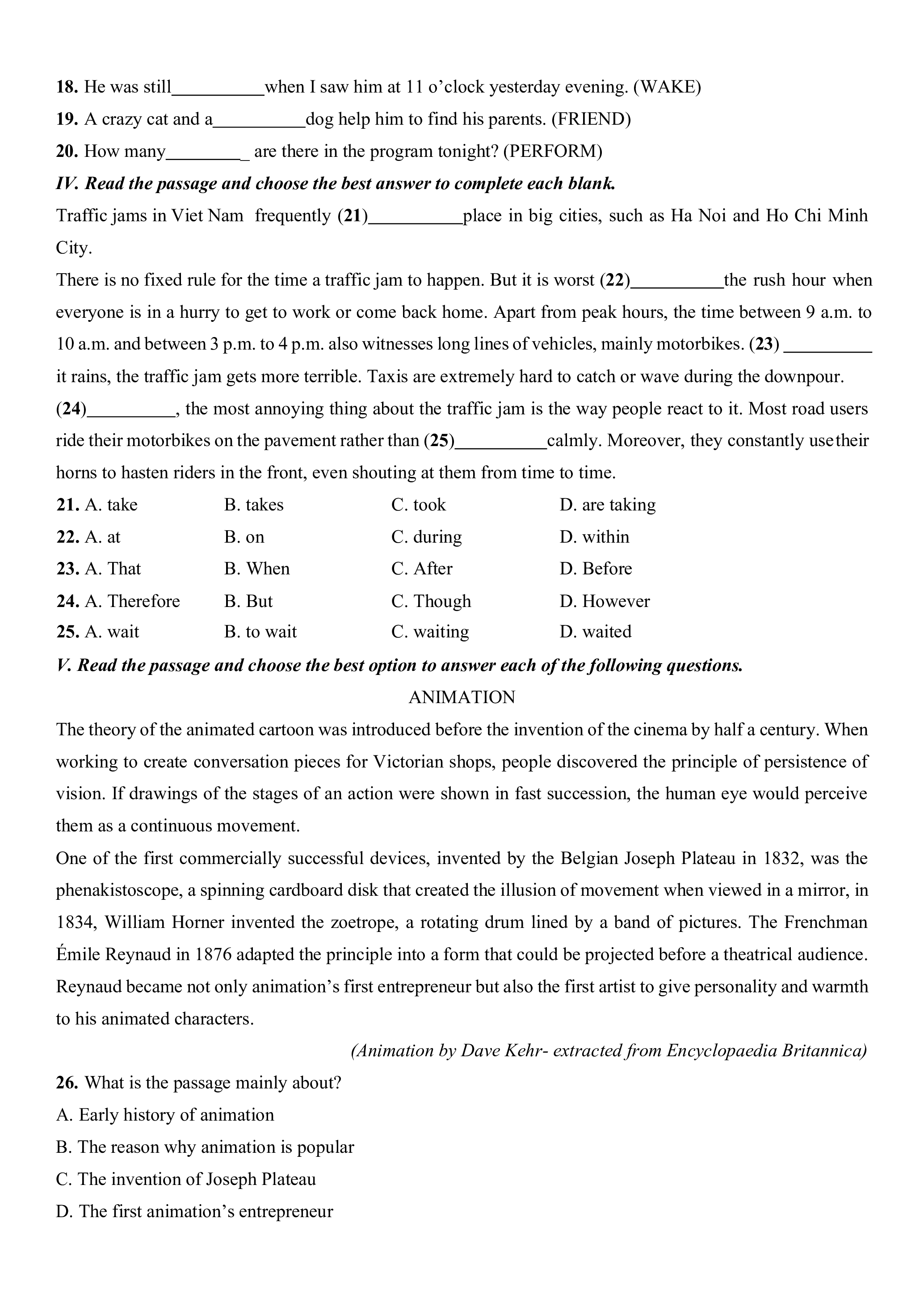
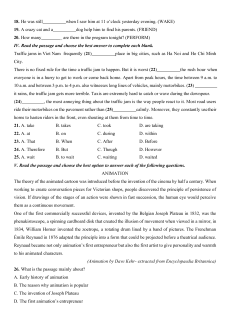
IV. Read the passage and choose the best answer to complete each blank.
Traffic jams in Viet Nam frequently (21)
place in big cities, such as Ha Noi and Ho Chi Minh City.
There is no fixed rule for the time a traffic jam to happen. But it is worst (22) the rush hour when
everyone is in a hurry to get to work or come back home. Apart from peak hours, the time between 9 a.m. to
10 a.m. and between 3 p.m. to 4 p.m. also witnesses long lines of vehicles, mainly motorbikes. (23)
it rains, the traffic jam gets more terrible. Taxis are extremely hard to catch or wave during the downpour. (24)
, the most annoying thing about the traffic jam is the way people react to it. Most road users
ride their motorbikes on the pavement rather than (25)
calmly. Moreover, they constantly use their
horns to hasten riders in the front, even shouting at them from time to time. 21. A. take B. takes C. took D. are taking 22. A. at B. on C. during D. within 23. A. That B. When C. After D. Before 24. A. Therefore B. But C. Though D. However 25. A. wait B. to wait C. waiting D. waited
V. Read the passage and choose the best option to answer each of the following questions. ANIMATION
The theory of the animated cartoon was introduced before the invention of the cinema by half a century. When
working to create conversation pieces for Victorian shops, people discovered the principle of persistence of
vision. If drawings of the stages of an action were shown in fast succession, the human eye would perceive
them as a continuous movement.
One of the first commercially successful devices, invented by the Belgian Joseph Plateau in 1832, was the
phenakistoscope, a spinning cardboard disk that created the illusion of movement when viewed in a mirror, in
1834, William Horner invented the zoetrope, a rotating drum lined by a band of pictures. The Frenchman
Émile Reynaud in 1876 adapted the principle into a form that could be projected before a theatrical audience.
Reynaud became not only animation’s first entrepreneur but also the first artist to give personality and warmth to his animated characters.
(Animation by Dave Kehr- extracted from Encyclopaedia Britannica)
26. What is the passage mainly about? A. Early history of animation
B. The reason why animation is popular
C. The invention of Joseph Plateau
D. The first animation’s entrepreneur
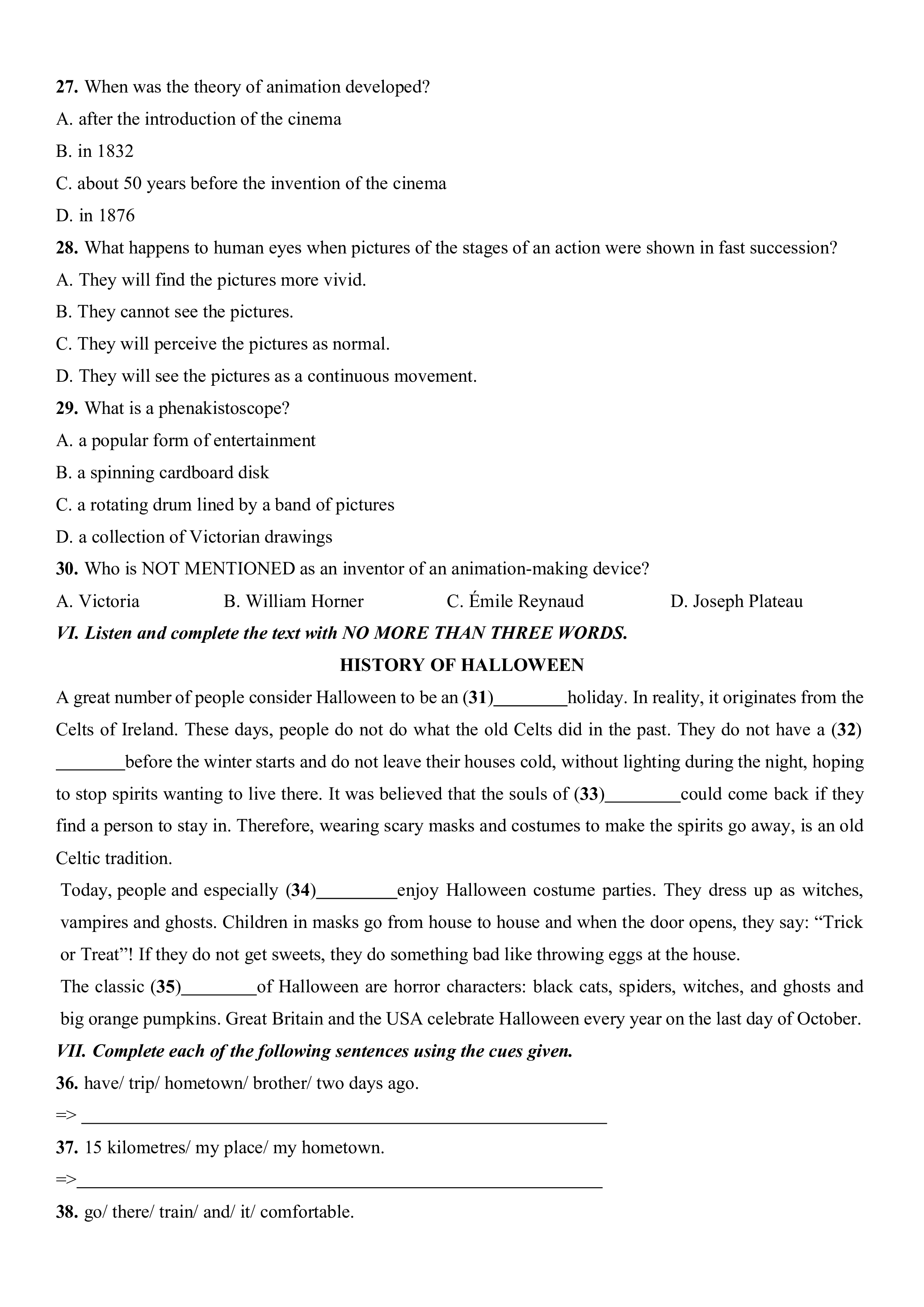
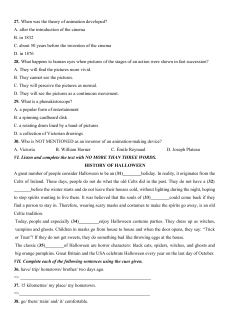
27. When was the theory of animation developed?
A. after the introduction of the cinema B. in 1832
C. about 50 years before the invention of the cinema D. in 1876
28. What happens to human eyes when pictures of the stages of an action were shown in fast succession?
A. They will find the pictures more vivid.
B. They cannot see the pictures.
C. They will perceive the pictures as normal.
D. They will see the pictures as a continuous movement.
29. What is a phenakistoscope?
A. a popular form of entertainment B. a spinning cardboard disk
C. a rotating drum lined by a band of pictures
D. a collection of Victorian drawings
30. Who is NOT MENTIONED as an inventor of an animation-making device? A. Victoria B. William Horner C. Émile Reynaud D. Joseph Plateau
VI. Listen and complete the text with NO MORE THAN THREE WORDS. HISTORY OF HALLOWEEN
A great number of people consider Halloween to be an (31)
holiday. In reality, it originates from the
Celts of Ireland. These days, people do not do what the old Celts did in the past. They do not have a (32)
before the winter starts and do not leave their houses cold, without lighting during the night, hoping
to stop spirits wanting to live there. It was believed that the souls of (33) could come back if they
find a person to stay in. Therefore, wearing scary masks and costumes to make the spirits go away, is an old Celtic tradition.
Today, people and especially (34)
enjoy Halloween costume parties. They dress up as witches,
vampires and ghosts. Children in masks go from house to house and when the door opens, they say: “Trick
or Treat”! If they do not get sweets, they do something bad like throwing eggs at the house. The classic (35)
of Halloween are horror characters: black cats, spiders, witches, and ghosts and
big orange pumpkins. Great Britain and the USA celebrate Halloween every year on the last day of October.
VII. Complete each of the following sentences using the cues given.
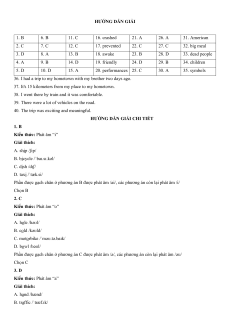
36. have/ trip/ hometown/ brother/ two days ago. =>
37. 15 kilometres/ my place/ my hometown. =>
38. go/ there/ train/ and/ it/ comfortable. =>
39. there/ a lot of/ vehicles/ road. =>
40. trip/ exciting/ meaningful. =>
---------------------THE END---------------------


Bộ 22 đề thi giữa kì 2 Tiếng Anh 7 Global success có đáp án
50.7 K
25.3 K lượt tải
150.000 ₫
MUA NGAY ĐỂ XEM TOÀN BỘ TÀI LIỆU
Hướng dẫn thanh toán: Tài liệu Giáo Dục
Bước 1
Gửi phí vào TK
- Số tài khoản
- 1133836868 (Xem mã QR ↗)
- Ngân hàng
- MB · CT TNHH DAU TU VA DV GD VIETJACK
Bước 2
Hotline hỗ trợ: 084 283 45 85
Chúng tôi đảm bảo đủ số lượng đề đã cam kết hoặc có thể nhiều hơn, tất cả có BẢN WORD, LỜI GIẢI CHI TIẾT và tải về dễ dàng.
Để tải tài liệu gốc về máy bạn click vào nút Tải Xuống ở trên!
- Tailieugiaovien.com.vn giới thiệu 22 Đề thi Giữa kì 2 môn Tiếng anh 7 Global success mới nhất nhằm giúp Giáo viên có thêm tài liệu tham khảo ra đề thi Tiếng anh lớp 7.
- Tài liệu gồm:
- 5 Đề thi GK2 Tiếng Anh 7 Global biên soạn có file nghe
- 17 Đề thi GK2 Tiếng Anh 7 trường/sở trên cả nước:
+ 7 Đề 2025-2026 (có file nghe);
+ 2 Đề 2024-2025 (có file nghe);
+ 3 Đề 2023-2024;
+ 2 Đề 2022-2023;
+ 3 Đề 2021-2022 - File word có lời giải chi tiết 100%.
Đánh giá
4.6 / 5(50670 )5
4
3
2
1

Trọng Bình
Tài liệu hay
Giúp ích cho tôi rất nhiều
Duy Trần
Tài liệu chuẩn
Rất thích tài liệu bên VJ soạn (bám sát chương trình dạy)
TÀI LIỆU BỘ BÁN CHẠY MÔN Tiếng Anh
Xem thêm-
 Bộ 26 đề thi giữa kì 1 Tiếng Anh 7 Global success có đáp án200.000 ₫ 67.4 K 33.7 K lượt tải
-
 Bài giảng Powerpoint Tiếng Anh 7 Global success250.000 ₫ 6.5 K 3.3 K lượt tải
-
Đề cương ôn tập Giữa kì 1 Tiếng Anh 7 Global Success80.000 ₫ 2.8 K 1.4 K lượt tải
-
Giáo án Tiếng Anh 7 Global success (năng lực số)200.000 ₫ - 250.000 ₫ 23.2 K 11.6 K lượt tải
-
Bộ 10 đề thi cuối kì 1 Tiếng Anh 7 Global success có đáp án150.000 ₫ 21.5 K 10.8 K lượt tải
-
Bộ trắc nghiệm Tiếng Anh 7 Global Success có đáp án150.000 ₫ 16.8 K 8.4 K lượt tải
-
Bộ 22 đề thi giữa kì 2 Tiếng Anh 7 Global success có đáp án150.000 ₫ 50.7 K 25.3 K lượt tải
-
Đề cương ôn tập Cuối kì 1 Tiếng Anh 7 Global Success80.000 ₫ 1.4 K 716 lượt tải
TÀI LIỆU BỘ BÁN CHẠY Lớp 7
Xem thêm-
Bộ 62 đề thi giữa kì 1 Toán 7 Kết nối tri thức Cấu trúc mới150.000 ₫ - 200.000 ₫ 98.6 K 49.3 K lượt tải
-
Bộ 25 đề thi giữa kì 1 Ngữ Văn 7 Kết nối tri thức Cấu trúc mới có đáp án150.000 ₫ 38.9 K 19.5 K lượt tải
-
Bộ đề thi Giữa kì 1 Lịch sử 7 Kết nối tri thức Cấu trúc mới70.000 ₫ 4.2 K 2.1 K lượt tải
-
Bộ 17 đề thi giữa kì 1 KHTN 7 Kết nối tri thức Cấu trúc mới150.000 ₫ 22.2 K 11.1 K lượt tải
-
Đề cương ôn tập Giữa kì 1 Toán 7 Kết nối tri thức cấu trúc mới80.000 ₫ 16.9 K 8.4 K lượt tải
-
Bộ 3 đề thi giữa kì 1 Lịch sử & Địa lý 7 Kết nối tri thức có đáp án70.000 ₫ 11.5 K 5.7 K lượt tải
-
Đề cương ôn tập giữa kì 1 Ngữ văn 7 Kết nối tri thức50.000 ₫ 6.9 K 3.5 K lượt tải
-
Bộ đề thi giữa kì 1 Địa lí 7 Kết nối tri thức Cấu trúc mới80.000 ₫ 3.6 K 1.8 K lượt tải

 Nhắn tin Zalo