



Date of planning: 03/09 / 2022 ENGLISH 10 WEEK : 1
Period 1: INTRODUCTION
INSTRUCTIONS FOR USING TEXTBOOKS, STUDYING MATERIALS
I. OBJECTIVES: By the end of the lesson students will be able to gain the following things: 1. Knowledge:
- To introduce new Tieng Anh 10 textbooks. Student’s book and Workbook
- Tell students something about Great Britain; England and English. Students learn how to study English well
and know the way to learn English.
*Vocabulary: Use lexical items related to text book, and the way to learn English in class; at home... some classroom languages.
* Grammar : to be; present simple tense; present continuous…
2. Competence: Students will be able to know how to study English effectively and how to use new Tieng
Anh 7 textbooks and know the methods to study new Tieng Anh 10 textbooks.
- Be collaborative and supportive in pair work and teamwork.
- Actively join in class activities
3.Qualities: To teach Ss the love of English; The awareness about importance of learning English. Developing self-study skills. II. TEACHING AIDS:
- Teacher: Grade 10 textbook, laptop, projector / TV/ pictures and cards.....
- Students : Text books, studying equipment….
- Computer connected to the Internet. - Sach mem.vn III. PROCEDURE:
1. WARM UP & INTRODUCTION ( 3’- 5’) Aims:
- To create a friendly and atmosphere in the class before the lesson;
- To give T and Ss a chance to introduce themselves;
- To lead into the unit
* Content: Have some warm-up activities to create a friendly and relaxed atmosphere to inspire Ss to warm up to the new class.
* Outcome: Having a chance to speak English and focus on the topic of the lesson..
* Organisation: Teacher’s instructions…
Teacher’s & Student’s activities Content + Greeting + Greeting + Chatting
+ Chatting. T_Ss
- Teacher (T) introduces himself/ herself
- T may introduce some warm-up activities to creat
- Students (Ss) listen and learn how to introduce
a friendly and relaxed atmosphere to inspire Ss to themselves. warm up to the new class…
- Introduce themselves (name; age; address; likes;
- Have Ss to introduce themselves. dislikes ….friends… )
+ Students (Ss) listen and learn how to do the tasks.
- T encourages Ss to talk in English as much as
- Answer the teacher’s questions possible - Open their book and write .
+ Lead to the first unit of the new school year.
- Write the unit title on the board and ask Ss guest
what they are going to learn this unit …
- Ask Ss to open their book and introduce what they are going to study….
2. NEW LESSON (12’-15’)
Aims: - To set the context for the introductory;
- To introduce the topic of the unit, the vocabulary, and the grammar points to be learned.
* Content: Some brief notes; Something about England, English. Introduce New ENGLISH 10
* Outcome: Ss learn something about England, English; Learn how to use New ENGLISH 10
* Organisation: Teacher’s instructions….
Teacher’s & Student’s activities Content
1. T. asks sts some questions about England. - T_Ss
- What do you know about England?
- Listen carefully and read aloud.
- T. gives sts something about England and English. - Fulfill teacher’s requirements
- It located in North-west coast of Europe with very - Give the answers
mild weather not too hot but not too cold. - Ss answer if possible
- It consists of four parts: England, Wales, Scotland - Listen carefully and read aloud. and Ireland.
- Find out the words related to the topic.
- It’s official name is the UK
- There are many interesting things of England and
- Each part has its own flag of UK.
you’ll gradually know about them in the progress of 2. English: learning English.
- How many people speak English as their mother
2/ Introduction: English is an international tongue?
language. Hundreds of million people speak English
- How many people speak English as their first
in the world. 400 million people speak English as language?
their first language, 600 million people speak
- How many people speak English as their second
English as their second language or first foreign
language or first foreign language?
language. 4/5 of the world’s computers use program - Why do you learn English?
in English. ¾ of all international correspondence is
- Is it important? Difficult? Useful? Interesting? in English.
=> It’s very important, useful, interesting. It is the 3/ English 10 has 10 Units.
means of communication to one another. - T_Ss 3/ New English 10 text book: - Each unit has 8 lessons.
- How many units are there in English 7 text book? - What are they about? - SECTION 5: LISTENING
There are 10 main units in the Student's Book. Each The listening activity follows the oral practice in the
unit has 8 sections and provides language input for Speaking section. It provides students with an
seven classroom lessons of 45 minutes each...At the opportunity to listen to the language that they have
beginning of each unit, there are explicit learning practised orally, and trains them to listen for general
objectives that clearly state the main language points and specific information
and skills to be taught in the unit.
This section aims to provide further practice to
- Section 1 : GETTING STARTED.
support students in their spoken English....
It begins with a conversation followed by activities - SECTION 6: WRITING.
which introduce the topic of the unit. It then presents Writing
the vocabulary and the grammar items to be learned This section focuses on developing students'writing
and practised through the skills and activities of the skills. It normally involves one of the text types unit.
required for students' skill development.
- Section 2: LANGUAGE FOCUS .
This section deals with the main grammar point(s) of SECTION 7: COMMUNICATION AND
the unit. The new language point(s) taught in this CULTURE
section is / are already introduced in Getting Started. It also gives students opportunities to learn and apply
The exercises are well illustrated to help students the cultural aspects of the language learnt to their
remember and use the grammar items effectively. lives and provides cultural information about Viet
The Remember! boxes appear wherever necessary to Nam and other countries.
give the rules or explanations and help students avoid Everyday English in this section gives students the common errors.
skills to communicate effectively in various everyday
This section presents and practises the grammar, situations...
vocabulary and pronunciation of the unit. The active - SECTION 8: LOOKING BACK
vocabulary of the unit is given in an interesting and
Looking Back recycles the language from the
illustrated way so that it is easy for students to
previous sections and links it with the unit topic. Its
memorise. Two sounds, which appear frequently in
activities and exercises are designed to help students
the unit, are given and practised in isolation and in
consolidate and apply what they have learnt in the
context. Stress pattern of two-syllable words, three-
unit. Teachers can use this section to evaluate their
syllable words, and rising and falling intonation for
students' performance and provide further practice if
questions are also dealt with in the last units of the necessary.
book. There are different exercises focusing on
The Project activity helps students improve their
intensive practice of vocabulary and pronunciation.
ability to work independently and in a team. It - SECTION 3: READING.
extends their imagination in a field related to the unit
This section is designed to help students inprove topic.
reading skill, use vocabulary in the situations,
* English is not too difficult but it requires you hard
Reading and this section aims to develop students' working.
reading abilities. The reading text is often based on
- Ss need learn by heart all vocabulary and their
the vocabulary and structures that students have usage.
previously acquired to make the activity achievable. - Review the lesson everyday. Speaking - Learn English everyday. - SECTION 4: SPEAKING
This section is designed to help students use
functional language in real life contexts and
consolidate what they have learnt in the previous sections. 3. PRACTICE (15’)
Aims: To help Ss understand the lesson. Class room language
* Content: Some brief notes; Something about England, English. Classroom language…
* Outcome: Ss learn something about England, English; Classroom languages…
* Organisation: Teacher’s instructions….
Teacher’s & Student’s activities Content
3. How to learn English best? - Tell us how you learn best? - T_Ss
- Tell us how you can learn English best? - Listen carefully
* Some useful classroom languages: - Who is the monitor?
- Practice saying classroom languages. - Who is absent today? - Who is on duty today?
- Work in groups; in pairs; present the projects…. - May I go out? - May I come in?.......
- How to improve your English:
- Listen to the teacher carefully, learn E. from many
sources, always enrich your vocabulary, do
exercises carefully, practice speaking, listening,
writing, reading everyday. …
- Ss should work hard everyday to improve their English.
“ Hard work is the key to success”
4. PRODUCTION/ FURTHER PRACTICE (8’)
Aims: To revise / teach classroom languages.
* Content: Some brief notes; Something about England, English . Classroom languages…
* Outcome: Ss know something about England, English; Classroom languages…
* Organisation: Teacher’s instructions…..
Teacher’s & Student’s activities Content - T_Ss
- The greetings : - Goodmorning
- T gives some questions to introduce the class - Good afternoon expressions. - Good morning - Good bye …. - Have Ss listen and repeat.
- We can say “May I go out”
- Teacher says “ go out, please”🡪 Go out
- You can say “Stand up, please.
- Teacher says “No” 🡪 Don’t go out - Listen, please
- Call on some pairs to practice in front of the class. - Read after me - Repeat please…..
5. WRAP-UP & HOME WORK (2’)
* Instruct/ guide students to do their homework.
- Prepare textbook, workbook, exercise book, * HOME WORK - Learn classroom languages.
- Prepare new lesson Unit one MY FAMILY
==============================
Date of planning: …/… / 20 …
Period 2: UNIT 1: FAMILY LIFE
Date of teaching: …/… / 20 …
Lesson 1: GETTING STARTED Household chores I. OBJECTIVES:
By the end of this lesson, students will be able to: 1. Knowledge:
- gain an overview of the topic Family life
- extend and practise vocabulary items about household chores.
- recognize and distinguish the basic usage of the Present Simple and Present Continuous tenses in context. 2. Competence:
- develop basic receptive skills (listening and reading for specific information) and productive
skills (speaking/presenting about household chores).
- work effectively in pairs and teams during learning activities. 3. Digital competence:
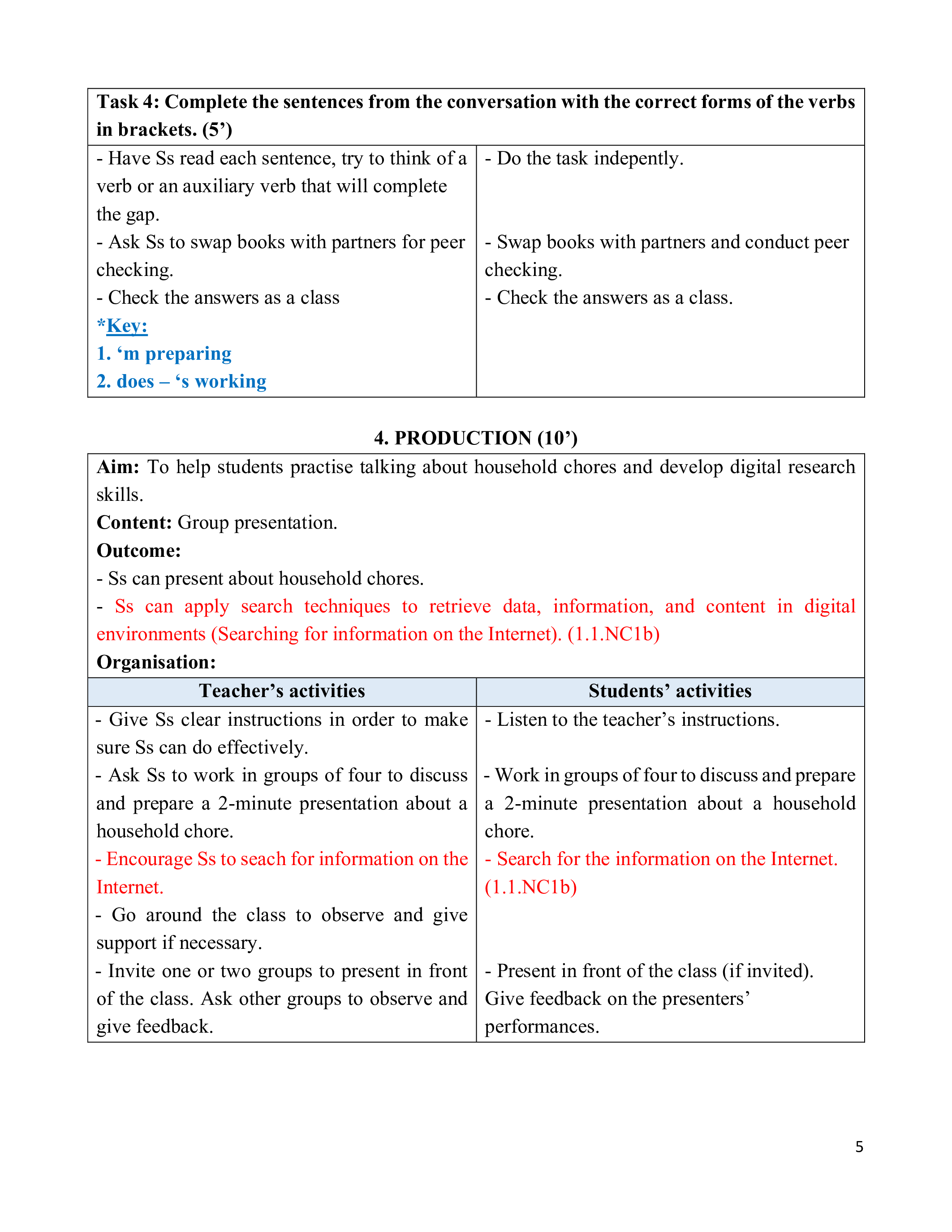
- apply search techniques to retrieve data, information, and content in digital environments
(searching for information on the Internet). (1.1.NC1b)
- evaluate the reliability and credibility of digital data, information, and content sources
(gathering information from diverse and reliable materials). (1.2.NC1a)
- apply ways to create and edit content in different formats (preparing the presentation using
digital tools such as Canva, Google Slides, or PowerPoint). (3.1.NC1a) 4. Attributes:
- show a sense of responsibility towards their own family by willingly sharing household chores.
- actively participate in classroom learning activities and group work. II. TEACHING AIDS:
- Teacher: Teacher’s Guide (pages 7 to 10), audio track 2, websites hoclieu.vn, PPT slides for
game “Let’s race”, internet access, laptop, pictures, textbook, lesson plan, TV or projector, cards of hobbies.
- Students: Student’s Book (pages 8 and 9), notebooks, smartphones / laptops / tablets,
Workbooks, and school supplies. III. PROCEDURE: 1. WARM UP (5’) Aims:
- To activate students’ knowledge on the topic of the unit.
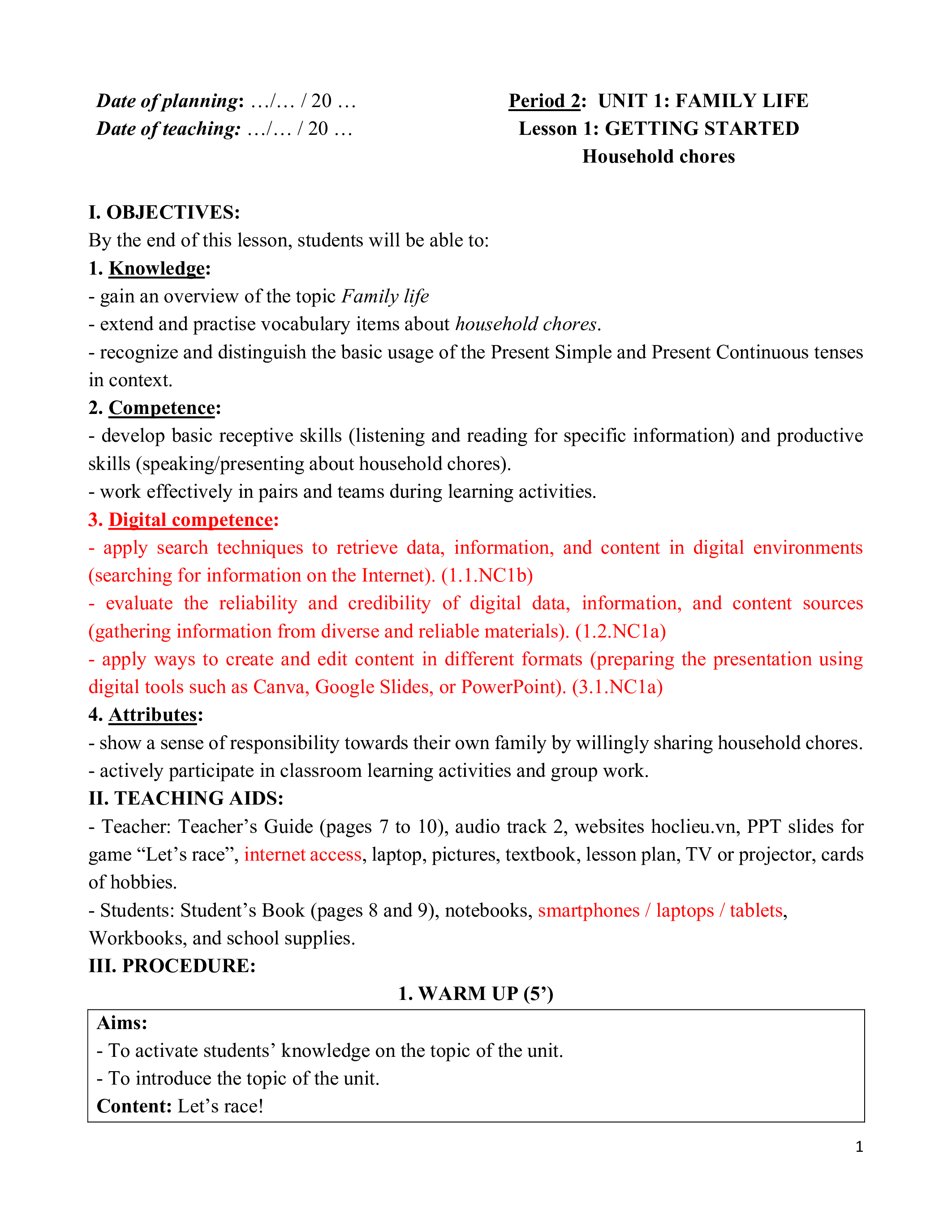
- To introduce the topic of the unit. Content: Let’s race! 1
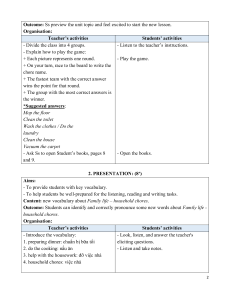
Outcome: Ss preview the unit topic and feel excited to start the new lesson. Organisation: Teacher’s activities Students’ activities
- Divide the class into 4 groups.
- Listen to the teacher’s instructions.
- Explain how to play the game:
+ Each picture represents one round. - Play the game.
+ On your turn, race to the board to write the chore name.
+ The fastest team with the correct answer
wins the point for that round.
+ The group with the most correct answers is the winner. *Suggested answers: Mop the floor Clean the toilet
Wash the clothes / Do the laundry Clean the house Vacuum the carpet
- Ask Ss to open Student’s books, pages 8 - Open the books. and 9.
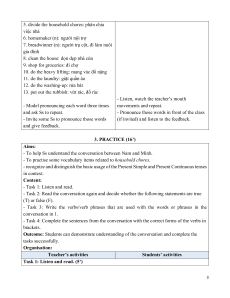
2. PRESENTATION: (8’) Aims:
- To provide students with key vocabulary.
- To help students be well-prepared for the listening, reading and writing tasks.
Content: new vocabulary about Family life – household chores.
Outcome: Students can identify and correctly pronounce some new words about Family life - household chores. Organisation: Teacher’s activities Students’ activities - Introduce the vocabulary:
- Look, listen, and answer the teacher's
1. preparing dinner: chuẩn bị bữa tối eliciting questions. 2. do the cooking: nấu ăn - Listen and take notes.
3. help with the housework: đỡ việc nhà
4. household chores: việc nhà 2
5. divide the household chores: phân chia việc nhà
6. homemaker (n): người nội trợ
7. breadwinner (n): người trụ cột, đi làm nuôi gia đình
8. clean the house: dọn dẹp nhà cừa
9. shop for groceries: đi chợ
10. do the heavy lifting: mang vác đồ nặng
11. do the laundry: giặt quần áo
12. do the washing-up: rửa bát
13. put out the rubbish: vứt rác, đổ rác
- Listen, watch the teacher’s mouth
- Model pronouncing each word three times movements and repeat. and ask Ss to repeat.
- Pronounce those words in front of the class
- Invite some Ss to pronounce those words
(if invited) and listen to the feedback. and give feedback. 3. PRACTICE (16’) Aims:
- To help Ss understand the conversation between Nam and Minh.
- To practise some vocabulary items related to household chores.
- recognize and distinguish the basic usage of the Present Simple and Present Continuous tenses in context. Content: - Task 1: Listen and read.
- Task 2: Read the conversation again and decide whether the following statements are true (T) or false (F).
- Task 3: Write the verbs/verb phrases that are used with the words or phrases in the conversation in 1.
- Task 4: Complete the sentences from the conversation with the correct forms of the verbs in brackets.
Outcome: Students can demonstrate understanding of the conversation and complete the tasks successfully. Organisation: Teacher’s activities Students’ activities
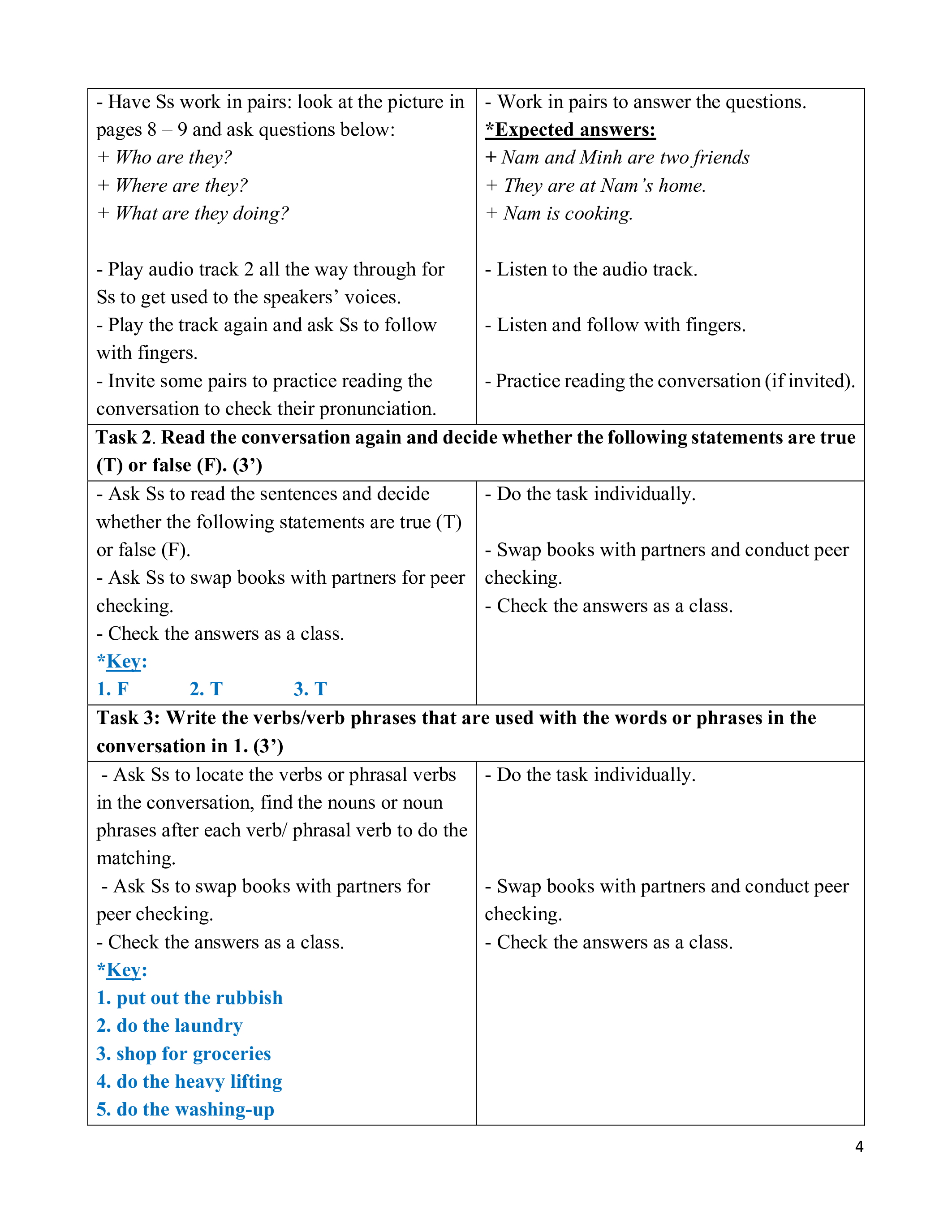
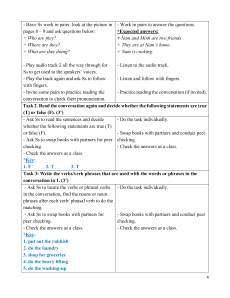
Task 1: Listen and read. (5’) 3
- Have Ss work in pairs: look at the picture in - Work in pairs to answer the questions.
pages 8 – 9 and ask questions below: *Expected answers: + Who are they?
+ Nam and Minh are two friends + Where are they?
+ They are at Nam’s home. + What are they doing?
+ Nam is cooking.
- Play audio track 2 all the way through for - Listen to the audio track.
Ss to get used to the speakers’ voices.
- Play the track again and ask Ss to follow
- Listen and follow with fingers. with fingers.
- Invite some pairs to practice reading the
- Practice reading the conversation (if invited).
conversation to check their pronunciation.
Task 2. Read the conversation again and decide whether the following statements are true (T) or false (F). (3’)
- Ask Ss to read the sentences and decide - Do the task individually.
whether the following statements are true (T) or false (F).
- Swap books with partners and conduct peer
- Ask Ss to swap books with partners for peer checking. checking.
- Check the answers as a class.
- Check the answers as a class. *Key: 1. F 2. T 3. T
Task 3: Write the verbs/verb phrases that are used with the words or phrases in the conversation in 1. (3’)
- Ask Ss to locate the verbs or phrasal verbs - Do the task individually.
in the conversation, find the nouns or noun
phrases after each verb/ phrasal verb to do the matching.
- Ask Ss to swap books with partners for
- Swap books with partners and conduct peer peer checking. checking.
- Check the answers as a class.
- Check the answers as a class. *Key: 1. put out the rubbish 2. do the laundry 3. shop for groceries
4. do the heavy lifting 5. do the washing-up 4
Date of planning: 03/09 / 2022 ENGLISH 10 WEEK : 1
Period 1: INTRODUCTION
INSTRUCTIONS FOR USING TEXTBOOKS, STUDYING MATERIALS
I. OBJECTIVES: By the end of the lesson students will be able to gain the following things: 1. Knowledge:
- To introduce new Tieng Anh 10 textbooks. Student’s book and Workbook
- Tell students something about Great Britain; England and English. Students learn how to study English well
and know the way to learn English.
*Vocabulary: Use lexical items related to text book, and the way to learn English in class; at home... some classroom languages.
* Grammar : to be; present simple tense; present continuous…
2. Competence: Students will be able to know how to study English effectively and how to use new Tieng
Anh 7 textbooks and know the methods to study new Tieng Anh 10 textbooks.
- Be collaborative and supportive in pair work and teamwork.
- Actively join in class activities
3.Qualities: To teach Ss the love of English; The awareness about importance of learning English. Developing self-study skills. II. TEACHING AIDS:
- Teacher: Grade 10 textbook, laptop, projector / TV/ pictures and cards.....
- Students : Text books, studying equipment….
- Computer connected to the Internet. - Sach mem.vn III. PROCEDURE:
1. WARM UP & INTRODUCTION ( 3’- 5’) Aims:
- To create a friendly and atmosphere in the class before the lesson;
- To give T and Ss a chance to introduce themselves;
- To lead into the unit
* Content: Have some warm-up activities to create a friendly and relaxed atmosphere to inspire Ss to warm up to the new class.
* Outcome: Having a chance to speak English and focus on the topic of the lesson..
* Organisation: Teacher’s instructions…
Teacher’s & Student’s activities Content + Greeting + Greeting + Chatting
+ Chatting. T_Ss
- Teacher (T) introduces himself/ herself
- T may introduce some warm-up activities to creat
- Students (Ss) listen and learn how to introduce
a friendly and relaxed atmosphere to inspire Ss to themselves. warm up to the new class…
- Introduce themselves (name; age; address; likes;
- Have Ss to introduce themselves. dislikes ….friends… )
+ Students (Ss) listen and learn how to do the tasks.
- T encourages Ss to talk in English as much as
- Answer the teacher’s questions possible - Open their book and write .
+ Lead to the first unit of the new school year.
- Write the unit title on the board and ask Ss guest
what they are going to learn this unit …
- Ask Ss to open their book and introduce what they are going to study….
2. NEW LESSON (12’-15’)
Aims: - To set the context for the introductory;
- To introduce the topic of the unit, the vocabulary, and the grammar points to be learned.
* Content: Some brief notes; Something about England, English. Introduce New ENGLISH 10
* Outcome: Ss learn something about England, English; Learn how to use New ENGLISH 10
* Organisation: Teacher’s instructions….
Teacher’s & Student’s activities Content
1. T. asks sts some questions about England. - T_Ss
- What do you know about England?
- Listen carefully and read aloud.
- T. gives sts something about England and English. - Fulfill teacher’s requirements
- It located in North-west coast of Europe with very - Give the answers
mild weather not too hot but not too cold. - Ss answer if possible
- It consists of four parts: England, Wales, Scotland - Listen carefully and read aloud. and Ireland.
- Find out the words related to the topic.
- It’s official name is the UK
- There are many interesting things of England and
- Each part has its own flag of UK.
you’ll gradually know about them in the progress of 2. English: learning English.
- How many people speak English as their mother
2/ Introduction: English is an international tongue?
language. Hundreds of million people speak English
- How many people speak English as their first
in the world. 400 million people speak English as language?
their first language, 600 million people speak
- How many people speak English as their second
English as their second language or first foreign
language or first foreign language?
language. 4/5 of the world’s computers use program - Why do you learn English?
in English. ¾ of all international correspondence is
- Is it important? Difficult? Useful? Interesting? in English.
=> It’s very important, useful, interesting. It is the 3/ English 10 has 10 Units.
means of communication to one another. - T_Ss 3/ New English 10 text book: - Each unit has 8 lessons.
- How many units are there in English 7 text book? - What are they about? - SECTION 5: LISTENING
There are 10 main units in the Student's Book. Each The listening activity follows the oral practice in the
unit has 8 sections and provides language input for Speaking section. It provides students with an
seven classroom lessons of 45 minutes each...At the opportunity to listen to the language that they have
beginning of each unit, there are explicit learning practised orally, and trains them to listen for general
objectives that clearly state the main language points and specific information
and skills to be taught in the unit.
This section aims to provide further practice to
- Section 1 : GETTING STARTED.
support students in their spoken English....
It begins with a conversation followed by activities - SECTION 6: WRITING.
which introduce the topic of the unit. It then presents Writing
the vocabulary and the grammar items to be learned This section focuses on developing students'writing
and practised through the skills and activities of the skills. It normally involves one of the text types unit.
required for students' skill development.
- Section 2: LANGUAGE FOCUS .
This section deals with the main grammar point(s) of SECTION 7: COMMUNICATION AND
the unit. The new language point(s) taught in this CULTURE
section is / are already introduced in Getting Started. It also gives students opportunities to learn and apply
The exercises are well illustrated to help students the cultural aspects of the language learnt to their
remember and use the grammar items effectively. lives and provides cultural information about Viet
The Remember! boxes appear wherever necessary to Nam and other countries.
give the rules or explanations and help students avoid Everyday English in this section gives students the common errors.
skills to communicate effectively in various everyday
This section presents and practises the grammar, situations...
vocabulary and pronunciation of the unit. The active - SECTION 8: LOOKING BACK
vocabulary of the unit is given in an interesting and
Looking Back recycles the language from the
illustrated way so that it is easy for students to
previous sections and links it with the unit topic. Its
memorise. Two sounds, which appear frequently in
activities and exercises are designed to help students
the unit, are given and practised in isolation and in
consolidate and apply what they have learnt in the
context. Stress pattern of two-syllable words, three-
unit. Teachers can use this section to evaluate their
syllable words, and rising and falling intonation for
students' performance and provide further practice if
questions are also dealt with in the last units of the necessary.
book. There are different exercises focusing on
The Project activity helps students improve their
intensive practice of vocabulary and pronunciation.
ability to work independently and in a team. It - SECTION 3: READING.
extends their imagination in a field related to the unit
This section is designed to help students inprove topic.
reading skill, use vocabulary in the situations,
* English is not too difficult but it requires you hard
Reading and this section aims to develop students' working.
reading abilities. The reading text is often based on
- Ss need learn by heart all vocabulary and their
the vocabulary and structures that students have usage.
previously acquired to make the activity achievable. - Review the lesson everyday. Speaking - Learn English everyday. - SECTION 4: SPEAKING
This section is designed to help students use
functional language in real life contexts and
consolidate what they have learnt in the previous sections. 3. PRACTICE (15’)
Aims: To help Ss understand the lesson. Class room language
* Content: Some brief notes; Something about England, English. Classroom language…
* Outcome: Ss learn something about England, English; Classroom languages…
* Organisation: Teacher’s instructions….
Teacher’s & Student’s activities Content
3. How to learn English best? - Tell us how you learn best? - T_Ss
- Tell us how you can learn English best? - Listen carefully
* Some useful classroom languages: - Who is the monitor?
- Practice saying classroom languages. - Who is absent today? - Who is on duty today?
- Work in groups; in pairs; present the projects…. - May I go out? - May I come in?.......
- How to improve your English:
- Listen to the teacher carefully, learn E. from many
sources, always enrich your vocabulary, do
exercises carefully, practice speaking, listening,
writing, reading everyday. …
- Ss should work hard everyday to improve their English.
“ Hard work is the key to success”
4. PRODUCTION/ FURTHER PRACTICE (8’)
Aims: To revise / teach classroom languages.
* Content: Some brief notes; Something about England, English . Classroom languages…
* Outcome: Ss know something about England, English; Classroom languages…
* Organisation: Teacher’s instructions…..
Teacher’s & Student’s activities Content - T_Ss
- The greetings : - Goodmorning
- T gives some questions to introduce the class - Good afternoon expressions. - Good morning - Good bye …. - Have Ss listen and repeat.
- We can say “May I go out”
- Teacher says “ go out, please”🡪 Go out
- You can say “Stand up, please.
- Teacher says “No” 🡪 Don’t go out - Listen, please
- Call on some pairs to practice in front of the class. - Read after me - Repeat please…..
5. WRAP-UP & HOME WORK (2’)
* Instruct/ guide students to do their homework.
- Prepare textbook, workbook, exercise book, * HOME WORK - Learn classroom languages.
- Prepare new lesson Unit one MY FAMILY
==============================

 Nhắn tin Zalo