
ệ đ xe ể m chi ti t ế (có l i ờ gi i ả )
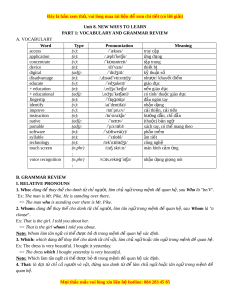
Unit 8. NEW WAYS TO LEARN
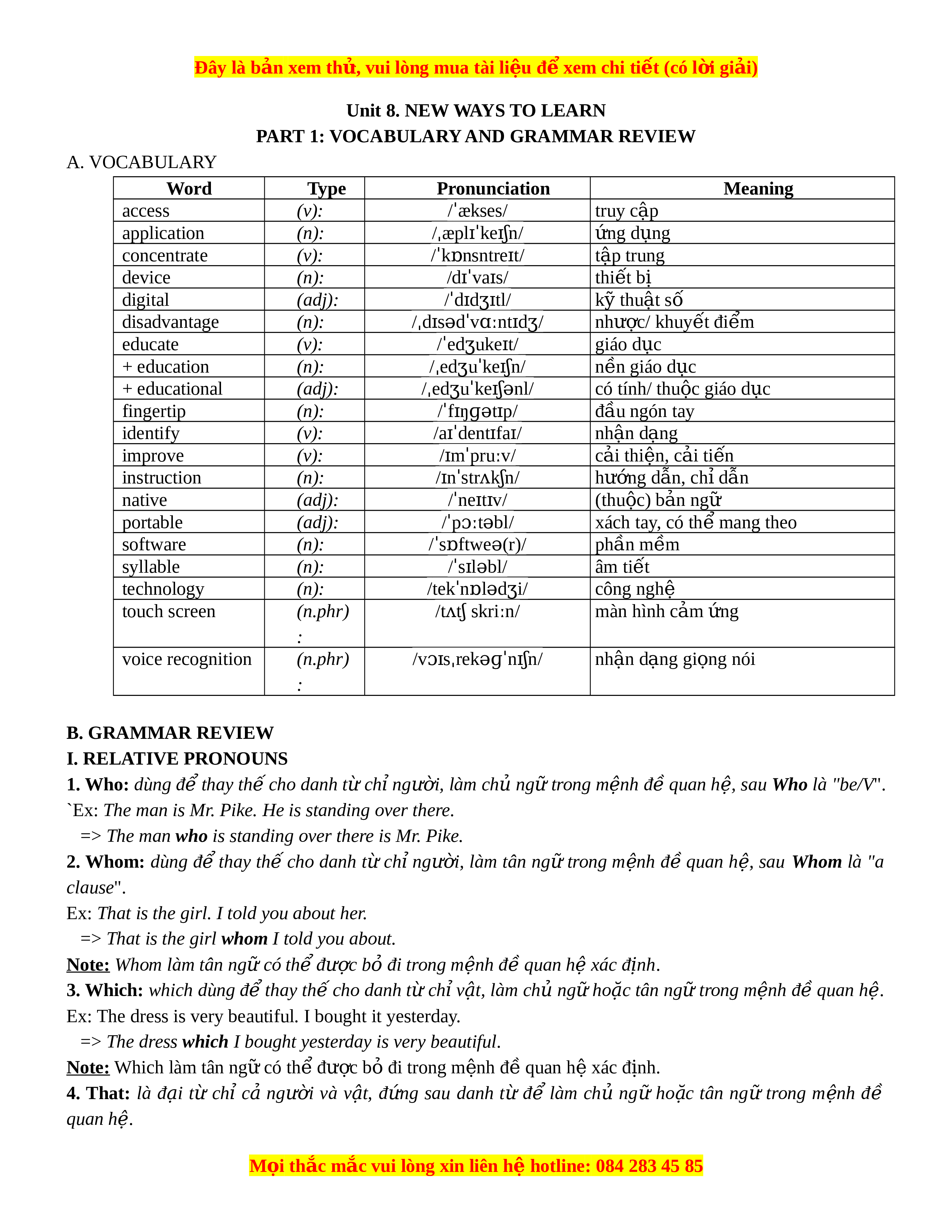
PART 1: VOCABULARY AND GRAMMAR REVIEW A. VOCABULARY Word Type Pronunciation Meaning access (v): /ˈækses/ truy cập application (n): /ˌæplɪˈkeɪʃn/ ng ứ d ng ụ concentrate (v): /ˈkɒnsntre t ɪ / tập trung device (n): /dɪ va ˈ s ɪ / thiết bị digital (adj): /ˈd d ɪ ʒ t ɪ l/ kỹ thuật số disadvantage (n): /ˌd s ɪ ədˈvɑ nt ː d ɪ ʒ/ như c ợ / khuy t ế đi m ể educate (v): /ˈedʒuke t ɪ / giáo d c ụ + education (n): /ˌedʒuˈkeɪʃn/ nền giáo d c ụ + educational (adj): /ˌedʒuˈkeɪʃənl/ có tính/ thu c ộ giáo d c ụ fingertip (n): /ˈf ŋ ɪ ɡət p ɪ / đầu ngón tay identify (v): /aɪ de ˈ nt fa ɪ ɪ/ nhận dạng improve (v): / m ɪ ˈpru v ː / cải thiện, cải tiến instruction (n): / n ɪ ˈstrʌkʃn/ hư ng ớ dẫn, chỉ dẫn native (adj): /ˈne t ɪ v ɪ / (thu c ộ ) bản ngữ portable (adj): /ˈpɔ t ː əbl/ xách tay, có th m ể ang theo software (n): / s ˈ ɒftwe (r) ə / phần mềm syllable (n): /ˈs l ɪ bl ə / âm tiết technology (n): /tekˈnɒlədʒi/ công nghệ touch screen (n.phr) /tʌtʃ skri n ː / màn hình cảm ng ứ : voice recognition (n.phr) /vɔ s ɪ ˌrekəɡˈnɪʃn/ nhận dạng gi ng ọ nói : B. GRAMMAR REVIEW I. RELATIVE PRONOUNS
1. Who: dùng để thay thế cho danh từ ch ng ỉ ư i ờ , làm chủ ng t ữ rong m nh đ ệ quan h ề , s
ệ au Who là "be/V".
`Ex: The man is Mr. Pike. He is standing over there.
=> The man who is standing over there is Mr. Pike.
2. Whom: dùng để thay thế cho danh từ chỉ ngư i ờ , làm tân ng ữ trong m nh ệ đ ề quan h ,
ệ sau Whom là "a clause".
Ex: That is the girl. I told you about her.
=> That is the girl whom I told you about.
Note: Whom làm tân ng c ữ ó th đ ể ư c ợ b đi ỏ trong m nh đ ệ quan h ề x ệ ác đ nh ị .
3. Which: which dùng để thay th c ế ho danh từ ch v ỉ ật, làm ch ng ủ ho ữ ặc tân ng t ữ rong m nh đ ệ quan h ề ệ.
Ex: The dress is very beautiful. I bought it yesterday.
=> The dress which I bought yesterday is very beautiful.
Note: Which làm tân ng c ữ ó thể đư c ợ bỏ đi trong m nh ệ đ qua ề n h xá ệ c đ nh. ị
4. That: là đại từ chỉ cả ngư i ờ và v t ậ , đ ng
ứ sau danh từ để làm chủ ngữ ho c
ặ tân ngữ trong m nh ệ đề quan hệ. M i
ọ thắc mắc vui lòng xin liên hệ hotline: 084 283 45 85
ệ đ xe ể m chi ti t ế (có l i ờ gi i ả )
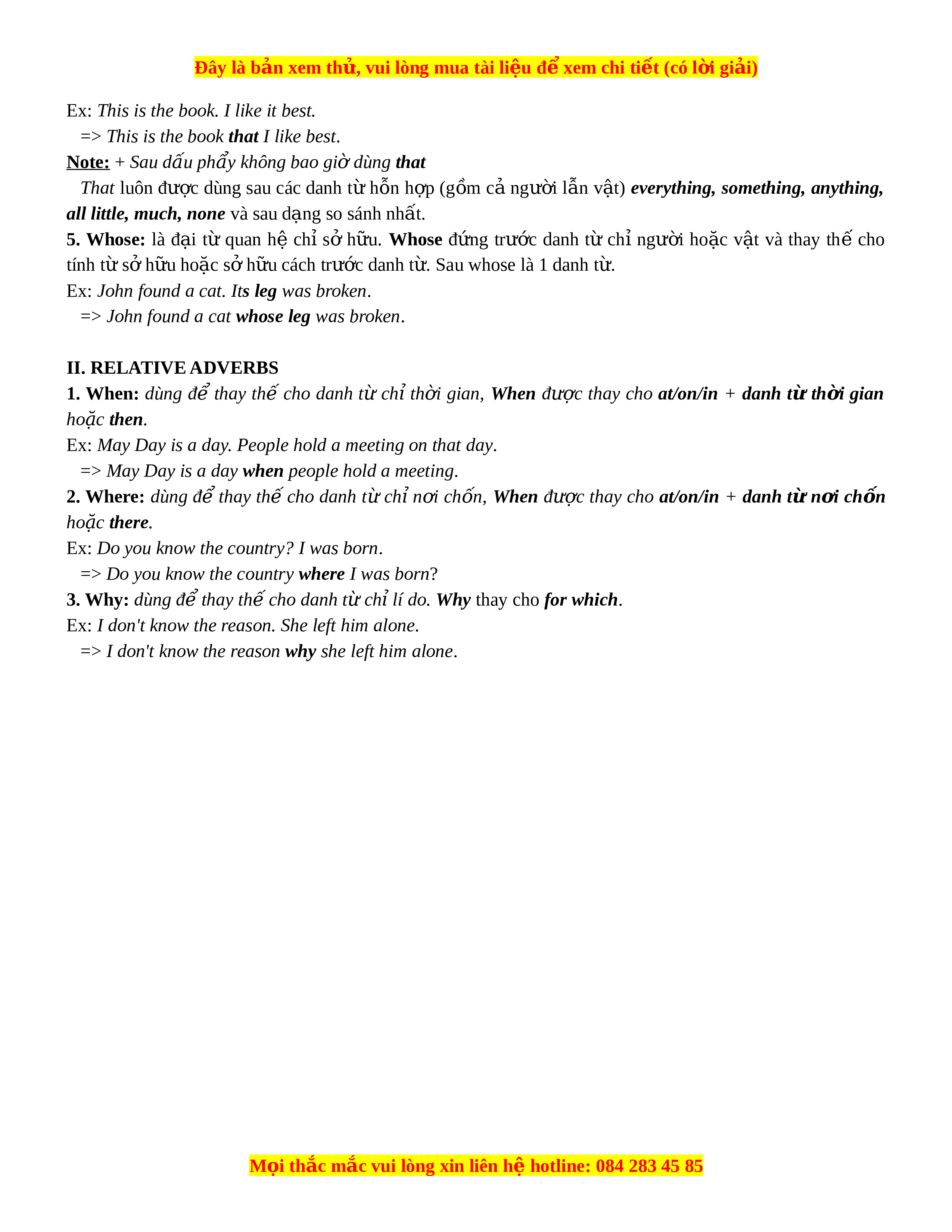
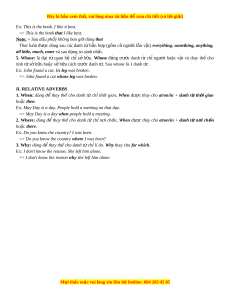
Ex: This is the book. I like it best.
=> This is the book that I like best.
Note: + Sau dấu phẩy không bao gi dùng ờ that That luôn đư c ợ dùng sau các danh t ừ h n ỗ h p ợ (g m ồ c ả ngư i ờ l n ẫ v t
ậ ) everything, something, anything,
all little, much, none và sau dạng so sánh nhất. 5. Whose: là đ i
ạ từ quan hệ chỉ sở h u. ữ Whose đ ng ứ trư c ớ danh từ chỉ ngư i ờ ho c ặ v t ậ và thay thế cho tính từ s h ở u ho ữ ặc s h ở u c ữ ách trư c ớ danh t . ừ Sau whose là 1 danh t . ừ
Ex: John found a cat. Its leg was broken.
=> John found a cat whose leg was broken. II. RELATIVE ADVERBS
1. When: dùng để thay thế cho danh từ chỉ th i
ờ gian, When đư c
ợ thay cho at/on/in + danh từ th i ờ gian hoặc then.
Ex: May Day is a day. People hold a meeting on that day.
=> May Day is a day when people hold a meeting.
2. Where: dùng để thay thế cho danh từ chỉ n i ơ ch n, ố When đư c
ợ thay cho at/on/in + danh từ n i ơ ch n ố hoặc there.
Ex: Do you know the country? I was born.
=> Do you know the country where I was born?
3. Why: dùng để thay thế cho danh từ ch l
ỉ í do. Why thay cho for which.
Ex: I don't know the reason. She left him alone.
=> I don't know the reason why she left him alone. M i
ọ thắc mắc vui lòng xin liên hệ hotline: 084 283 45 85
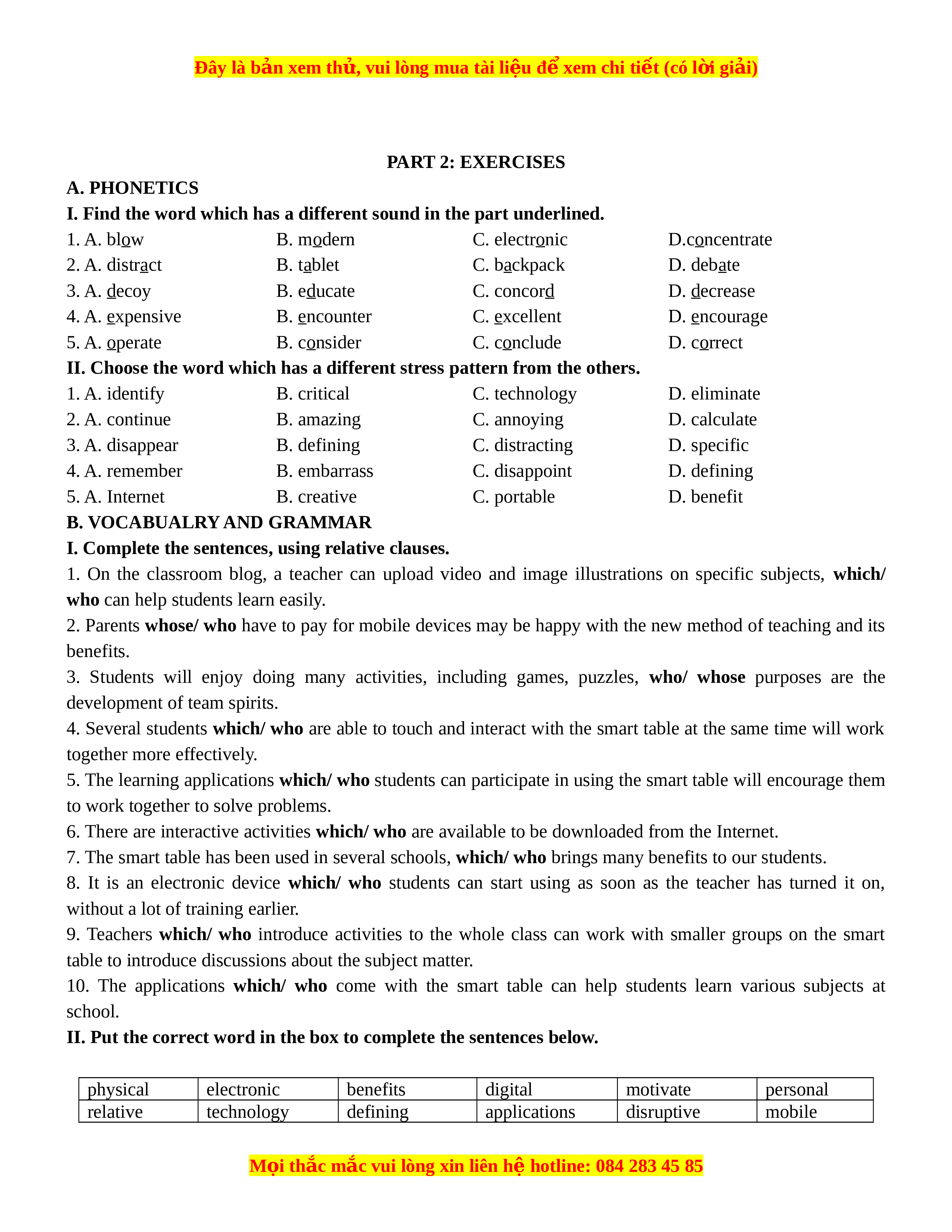
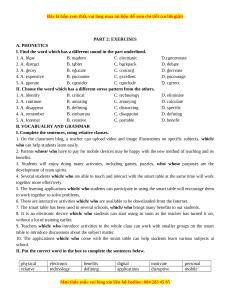
ệ đ xe ể m chi ti t ế (có l i ờ gi i ả ) PART 2: EXERCISES A. PHONETICS
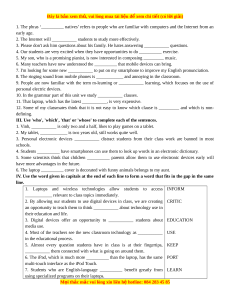
I. Find the word which has a different sound in the part underlined. 1. A. blow B. modern C. electronic D.concentrate 2. A. distract B. tablet C. backpack D. debate 3. A. decoy B. educate C. concord D. decrease 4. A. expensive B. encounter C. excellent D. encourage 5. A. operate B. consider C. conclude D. correct
II. Choose the word which has a different stress pattern from the others. 1. A. identify B. critical C. technology D. eliminate 2. A. continue B. amazing C. annoying D. calculate 3. A. disappear B. defining C. distracting D. specific 4. A. remember B. embarrass C. disappoint D. defining 5. A. Internet B. creative C. portable D. benefit B. VOCABUALRY AND GRAMMAR
I. Complete the sentences, using relative clauses.
1. On the classroom blog, a teacher can upload video and image illustrations on specific subjects, which/
who can help students learn easily.
2. Parents whose/ who have to pay for mobile devices may be happy with the new method of teaching and its benefits.
3. Students will enjoy doing many activities, including games, puzzles, who/ whose purposes are the development of team spirits.
4. Several students which/ who are able to touch and interact with the smart table at the same time will work together more effectively.
5. The learning applications which/ who students can participate in using the smart table will encourage them
to work together to solve problems.
6. There are interactive activities which/ who are available to be downloaded from the Internet.
7. The smart table has been used in several schools, which/ who brings many benefits to our students.
8. It is an electronic device which/ who students can start using as soon as the teacher has turned it on,
without a lot of training earlier.
9. Teachers which/ who introduce activities to the whole class can work with smaller groups on the smart
table to introduce discussions about the subject matter.
10. The applications which/ who come with the smart table can help students learn various subjects at school.
II. Put the correct word in the box to complete the sentences below. physical electronic benefits digital motivate personal relative technology defining applications disruptive mobile M i
ọ thắc mắc vui lòng xin liên hệ hotline: 084 283 45 85
ệ đ xe ể m chi ti t ế (có l i ờ gi i ả )
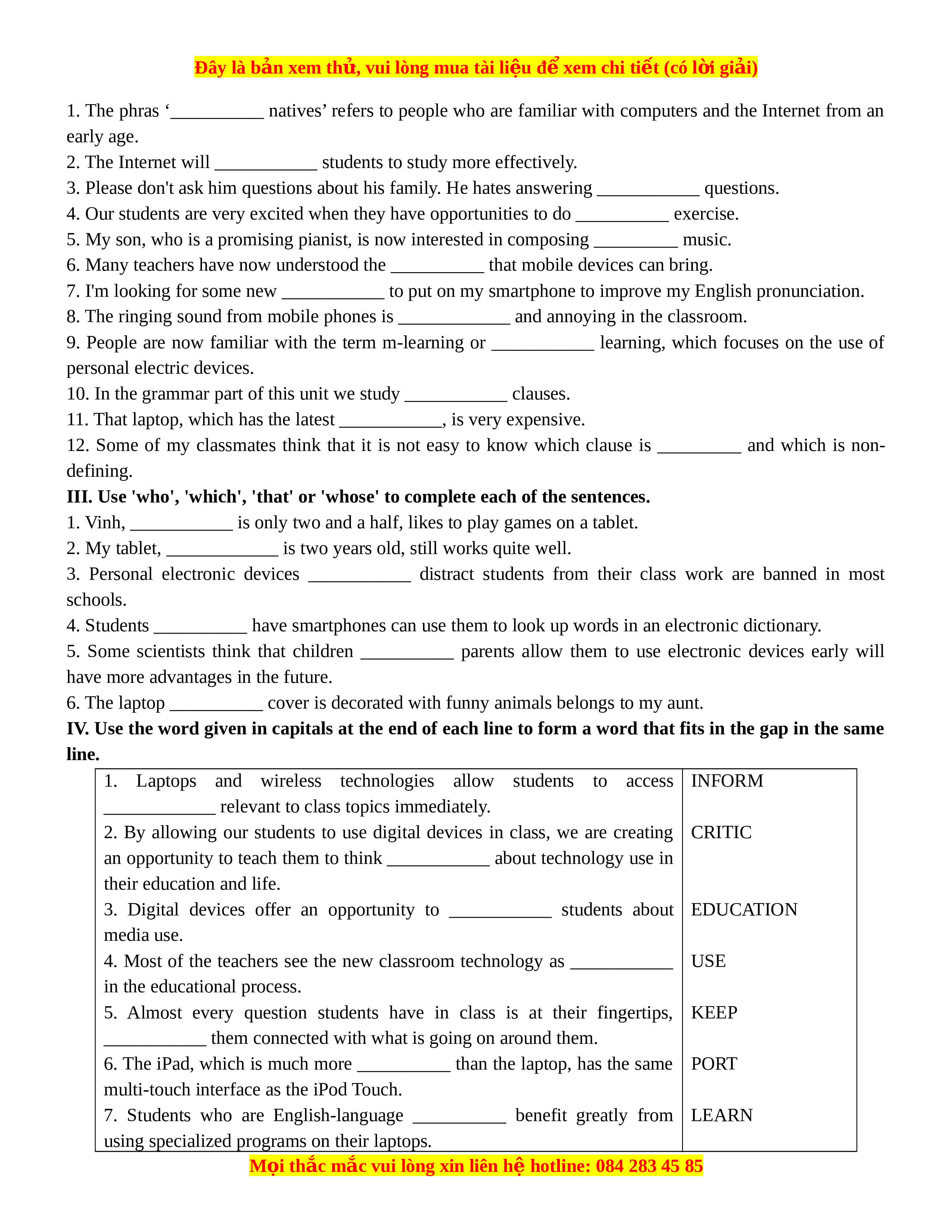
1. The phras ‘__________ natives’ refers to people who are familiar with computers and the Internet from an early age.
2. The Internet will ___________ students to study more effectively.
3. Please don't ask him questions about his family. He hates answering ___________ questions.
4. Our students are very excited when they have opportunities to do __________ exercise.
5. My son, who is a promising pianist, is now interested in composing _________ music.
6. Many teachers have now understood the __________ that mobile devices can bring.
7. I'm looking for some new ___________ to put on my smartphone to improve my English pronunciation.
8. The ringing sound from mobile phones is ____________ and annoying in the classroom.
9. People are now familiar with the term m-learning or ___________ learning, which focuses on the use of personal electric devices.
10. In the grammar part of this unit we study ___________ clauses.
11. That laptop, which has the latest ___________, is very expensive.
12. Some of my classmates think that it is not easy to know which clause is _________ and which is non- defining.
III. Use 'who', 'which', 'that' or 'whose' to complete each of the sentences.
1. Vinh, ___________ is only two and a half, likes to play games on a tablet.
2. My tablet, ____________ is two years old, still works quite well.
3. Personal electronic devices ___________ distract students from their class work are banned in most schools.
4. Students __________ have smartphones can use them to look up words in an electronic dictionary.
5. Some scientists think that children __________ parents allow them to use electronic devices early will
have more advantages in the future.
6. The laptop __________ cover is decorated with funny animals belongs to my aunt.
IV. Use the word given in capitals at the end of each line to form a word that fits in the gap in the same line.
1. Laptops and wireless technologies allow students to access INFORM
____________ relevant to class topics immediately.
2. By allowing our students to use digital devices in class, we are creating CRITIC
an opportunity to teach them to think ___________ about technology use in their education and life.
3. Digital devices offer an opportunity to ___________ students about EDUCATION media use.
4. Most of the teachers see the new classroom technology as ___________ USE in the educational process.
5. Almost every question students have in class is at their fingertips, KEEP
___________ them connected with what is going on around them.
6. The iPad, which is much more __________ than the laptop, has the same PORT
multi-touch interface as the iPod Touch.
7. Students who are English-language __________ benefit greatly from LEARN
using specialized programs on their laptops. M i
ọ thắc mắc vui lòng xin liên hệ hotline: 084 283 45 85
Bài tập Unit 8: New ways to learn Tiếng Anh 10 - Bùi Văn Vinh
348
174 lượt tải
0 ₫
MUA NGAY ĐỂ XEM TOÀN BỘ TÀI LIỆU
CÁCH MUA:
- B1: Gửi phí vào TK:
1133836868- CT TNHH DAU TU VA DV GD VIETJACK - Ngân hàng MB (QR) - B2: Nhắn tin tới Zalo VietJack Official ( nhấn vào đây ) để xác nhận thanh toán và tải tài liệu - giáo án
Liên hệ ngay Hotline hỗ trợ: 084 283 45 85
Tài liệu được cập nhật liên tục trong gói này từ nay đến hết tháng 6/2023. Chúng tôi đảm bảo đủ số lượng đề đã cam kết hoặc có thể nhiều hơn, tất cả có BẢN WORD, LỜI GIẢI CHI TIẾT và tải về dễ dàng.
Để tải tài liệu gốc về máy bạn click vào nút Tải Xuống ở trên!
Thuộc bộ (mua theo bộ để tiết kiệm hơn):
- Tailieugiaovien.com.vn giới thiệu Bộ bài tập Tiếng Anh lớp 10 biên soạn bởi GV Bùi Văn Vinh mới nhất nhằm giúp Giáo viên có thêm tài liệu tham khảo bài tập Tiếng Anh lớp 10.
- File word có lời giải chi tiết 100%.
- Mua trọn bộ sẽ tiết kiệm hơn tải lẻ 50%.
Đánh giá
4.6 / 5(348 )5
4
3
2
1

Trọng Bình
Tài liệu hay
Giúp ích cho tôi rất nhiều
Duy Trần
Tài liệu chuẩn
Rất thích tài liệu bên VJ soạn (bám sát chương trình dạy)
TÀI LIỆU BỘ BÁN CHẠY MÔN Tiếng Anh
Xem thêm-
 Giáo án Tiếng Anh 10 Global success (năng lực số)200.000 ₫ - 250.000 ₫ 16.3 K 8.2 K lượt tải
-
Bài giảng Powerpoint Tiếng Anh 10 Global success300.000 ₫ 13.8 K 6.9 K lượt tải
-
Bài tập từ vựng Tiếng Anh 10 Global success mới nhất100.000 ₫ 1.7 K 828 lượt tải
-
Practice test Tiếng Anh 10 Global success (cả năm) có lời giải100.000 ₫ 3.7 K 1.8 K lượt tải
-
Bộ 20 đề thi cuối kì 2 Tiếng Anh 10 Global success có đáp án180.000 ₫ 14.8 K 7.4 K lượt tải
-
Đề khảo sát chất lượng đầu năm lớp 10 Tiếng Anh60.000 ₫ 565 283 lượt tải
-
Giáo án Tiếng Anh 10 Global success CV 5512 | Giáo án Tiếng Anh 10 mới chuẩn nhất250.000 ₫ 2.4 K 1.2 K lượt tải
-
Đề cương ôn tập Cuối kì 2 Tiếng Anh 10 ilearn Smart world80.000 ₫ 520 260 lượt tải
TÀI LIỆU BỘ BÁN CHẠY Lớp 10
Xem thêm-
Giáo án Hoạt động trải nghiệm 10 Kết nối tri thức (năng lực số)200.000 ₫ - 250.000 ₫ 1.5 K 735 lượt tải
-
Bài giảng Powerpoint KTPL 10 Kết nối tri thức350.000 ₫ 5.1 K 2.6 K lượt tải
-
 Khung năng lực số môn Hóa học 10 (mới nhất)30.000 ₫ 510 255 lượt tải
-
Chuyên đề dạy thêm Vật lí 10 (sách mới) có đáp án200.000 ₫ 10.9 K 5.5 K lượt tải
-
Giáo án Toán 10 Kết nối tri thức (năng lực số)300.000 ₫ - 350.000 ₫ 23.1 K 11.5 K lượt tải
-
Giáo án KTPL 10 Kết nối tri thức (năng lực số)300.000 ₫ 8.1 K 4 K lượt tải
-
Giáo án Hóa học 10 Kết nối tri thức (năng lực số200.000 ₫ - 250.000 ₫ 9.2 K 4.6 K lượt tải
-
Bài giảng Powerpoint Ngữ văn 10 Kết nối tri thức350.000 ₫ 7.8 K 3.9 K lượt tải
Tài liệu bộ mới nhất

Đây là b nả xem thử, vui lòng mua tài li u đ xem chi ti t (có l i gi i)ệ ể ế ờ ả
Unit 8. NEW WAYS TO LEARN
PART 1: VOCABULARY AND GRAMMAR REVIEW
A. VOCABULARY
Word Type Pronunciation Meaning
access (v): / æksesˈ / truy c pậ
application (n): / æpl ke nˌ ɪˈ ɪʃ / ng d ngứ ụ
concentrate (v): / k nsntre tˈ ɒ ɪ / t p trungậ
device (n): /d va sɪˈ ɪ / thi t bế ị
digital (adj): / d d tlˈ ɪ ʒɪ / k thu t sỹ ậ ố
disadvantage (n): / d s d v nt dˌ ɪ ə ˈ ɑː ɪ ʒ/ nh c/ khuy t đi mượ ế ể
educate (v): / ed uke tˈ ʒ ɪ / giáo d cụ
+ education (n): / ed u ke nˌ ʒ ˈ ɪʃ / n n giáo d cề ụ
+ educational (adj): / ed u ke nlˌ ʒ ˈ ɪʃə / có tính/ thu c giáo d cộ ụ
fingertip (n): / f ŋ t pˈ ɪ ɡə ɪ / đ u ngón tayầ
identify (v): /a dent faɪˈ ɪ ɪ/ nh n d ngậ ạ
improve (v): / m pru vɪ ˈ ː / c i thi n, c i ti nả ệ ả ế
instruction (n): / n str k nɪ ˈ ʌ ʃ / h ng d n, ch d nướ ẫ ỉ ẫ
native (adj): / ne t vˈ ɪ ɪ / (thu c) b n ngộ ả ữ
portable (adj): / p t blˈ ɔː ə / xách tay, có th mang theoể
software (n): / s ftwe (r)ˈ ɒ ə / ph n m mầ ề
syllable (n): / s l blˈ ɪ ə / âm ti tế
technology (n): /tek n l d iˈ ɒ ə ʒ / công nghệ
touch screen (n.phr)
:
/t tʌ ʃ skri nː / màn hình c m ngả ứ
voice recognition (n.phr)
:
/v s rek n nɔɪ ˌ əɡˈ ɪʃ / nh n d ng gi ng nóiậ ạ ọ
B. GRAMMAR REVIEW
I. RELATIVE PRONOUNS
1. Who: dùng đ thay th cho danh t ch ng i, làm ch ng trong m nh đ quan h , sau ể ế ừ ỉ ườ ủ ữ ệ ề ệ Who là "be/V".
`Ex: The man is Mr. Pike. He is standing over there.
=> The man who is standing over there is Mr. Pike.
2. Whom: dùng đ thay th cho danh t ch ng i, làm tân ng trong m nh đ quan h , sau ể ế ừ ỉ ườ ữ ệ ề ệ Whom là "a
clause".
Ex: That is the girl. I told you about her.
=> That is the girl whom I told you about.
Note: Whom làm tân ng có th đ c b đi trong m nh đ quan h xác đ nhữ ể ượ ỏ ệ ề ệ ị .
3. Which: which dùng đ thay th cho danh t ch v t, làm ch ng ho c tân ng trong m nh đ quan hể ế ừ ỉ ậ ủ ữ ặ ữ ệ ề ệ.
Ex: The dress is very beautiful. I bought it yesterday.
=> The dress which I bought yesterday is very beautiful.
Note: Which làm tân ng có th đ c b đi trong m nh đ quan h xác đ nh. ữ ể ượ ỏ ệ ề ệ ị
4. That: là đ i t ch c ng i và v t, đ ng sau danh t đ làm ch ng ho c tân ng trong m nh đạ ừ ỉ ả ườ ậ ứ ừ ể ủ ữ ặ ữ ệ ề
quan hệ.
M iọ th c m c vui lòng xin liên hắ ắ ệ hotline: 084 283 45 85

Đây là b nả xem thử, vui lòng mua tài li u đ xem chi ti t (có l i gi i)ệ ể ế ờ ả
Ex: This is the book. I like it best.
=> This is the book that I like best.
Note: + Sau d u ph y không bao gi dùngấ ẩ ờ that
That luôn đ c dùng sau các danh t h n h p (g m c ng i l n v t) ượ ừ ỗ ợ ồ ả ườ ẫ ậ everything, something, anything,
all little, much, none và sau d ng so sánh nh t. ạ ấ
5. Whose: là đ i t quan h ch s h u. ạ ừ ệ ỉ ở ữ Whose đ ng tr c danh t ch ng i ho c v t và thay th choứ ướ ừ ỉ ườ ặ ậ ế
tính t s h u ho c s h u cách tr c danh t . Sau whose là 1 danh t .ừ ở ữ ặ ở ữ ướ ừ ừ
Ex: John found a cat. Its leg was broken.
=> John found a cat whose leg was broken.
II. RELATIVE ADVERBS
1. When: dùng đ thay th cho danh t ch th i gian, ể ế ừ ỉ ờ When đ c thay cho ượ at/on/in + danh t th i gianừ ờ
ho c ặ then.
Ex: May Day is a day. People hold a meeting on that day.
=> May Day is a day when people hold a meeting.
2. Where: dùng đ thay th cho danh t ch n i ch n, ể ế ừ ỉ ơ ố When đ c thay cho ượ at/on/in + danh t n i ch nừ ơ ố
ho c ặ there.
Ex: Do you know the country? I was born.
=> Do you know the country where I was born?
3. Why: dùng đ thay th cho danh t ch lí do. ể ế ừ ỉ Why thay cho for which.
Ex: I don't know the reason. She left him alone.
=> I don't know the reason why she left him alone.
M iọ th c m c vui lòng xin liên hắ ắ ệ hotline: 084 283 45 85

Đây là b nả xem thử, vui lòng mua tài li u đ xem chi ti t (có l i gi i)ệ ể ế ờ ả
PART 2: EXERCISES
A. PHONETICS
I. Find the word which has a different sound in the part underlined.
1. A. blow B. modern C. electronic D.concentrate
2. A. distract B. tablet C. backpack D. debate
3. A. decoy B. educate C. concord D. decrease
4. A. expensive B. encounter C. excellent D. encourage
5. A. operate B. consider C. conclude D. correct
II. Choose the word which has a different stress pattern from the others.
1. A. identify B. critical C. technology D. eliminate
2. A. continue B. amazing C. annoying D. calculate
3. A. disappear B. defining C. distracting D. specific
4. A. remember B. embarrass C. disappoint D. defining
5. A. Internet B. creative C. portable D. benefit
B. VOCABUALRY AND GRAMMAR
I. Complete the sentences, using relative clauses.
1. On the classroom blog, a teacher can upload video and image illustrations on specific subjects, which/
who can help students learn easily.
2. Parents whose/ who have to pay for mobile devices may be happy with the new method of teaching and its
benefits.
3. Students will enjoy doing many activities, including games, puzzles, who/ whose purposes are the
development of team spirits.
4. Several students which/ who are able to touch and interact with the smart table at the same time will work
together more effectively.
5. The learning applications which/ who students can participate in using the smart table will encourage them
to work together to solve problems.
6. There are interactive activities which/ who are available to be downloaded from the Internet.
7. The smart table has been used in several schools, which/ who brings many benefits to our students.
8. It is an electronic device which/ who students can start using as soon as the teacher has turned it on,
without a lot of training earlier.
9. Teachers which/ who introduce activities to the whole class can work with smaller groups on the smart
table to introduce discussions about the subject matter.
10. The applications which/ who come with the smart table can help students learn various subjects at
school.
II. Put the correct word in the box to complete the sentences below.
physical electronic benefits digital motivate personal
relative technology defining applications disruptive mobile
M iọ th c m c vui lòng xin liên hắ ắ ệ hotline: 084 283 45 85

Đây là b nả xem thử, vui lòng mua tài li u đ xem chi ti t (có l i gi i)ệ ể ế ờ ả
1. The phras ‘__________ natives’ refers to people who are familiar with computers and the Internet from an
early age.
2. The Internet will ___________ students to study more effectively.
3. Please don't ask him questions about his family. He hates answering ___________ questions.
4. Our students are very excited when they have opportunities to do __________ exercise.
5. My son, who is a promising pianist, is now interested in composing _________ music.
6. Many teachers have now understood the __________ that mobile devices can bring.
7. I'm looking for some new ___________ to put on my smartphone to improve my English pronunciation.
8. The ringing sound from mobile phones is ____________ and annoying in the classroom.
9. People are now familiar with the term m-learning or ___________ learning, which focuses on the use of
personal electric devices.
10. In the grammar part of this unit we study ___________ clauses.
11. That laptop, which has the latest ___________, is very expensive.
12. Some of my classmates think that it is not easy to know which clause is _________ and which is non-
defining.
III. Use 'who', 'which', 'that' or 'whose' to complete each of the sentences.
1. Vinh, ___________ is only two and a half, likes to play games on a tablet.
2. My tablet, ____________ is two years old, still works quite well.
3. Personal electronic devices ___________ distract students from their class work are banned in most
schools.
4. Students __________ have smartphones can use them to look up words in an electronic dictionary.
5. Some scientists think that children __________ parents allow them to use electronic devices early will
have more advantages in the future.
6. The laptop __________ cover is decorated with funny animals belongs to my aunt.
IV. Use the word given in capitals at the end of each line to form a word that fits in the gap in the same
line.
1. Laptops and wireless technologies allow students to access
____________ relevant to class topics immediately.
2. By allowing our students to use digital devices in class, we are creating
an opportunity to teach them to think ___________ about technology use in
their education and life.
3. Digital devices offer an opportunity to ___________ students about
media use.
4. Most of the teachers see the new classroom technology as ___________
in the educational process.
5. Almost every question students have in class is at their fingertips,
___________ them connected with what is going on around them.
6. The iPad, which is much more __________ than the laptop, has the same
multi-touch interface as the iPod Touch.
7. Students who are English-language __________ benefit greatly from
using specialized programs on their laptops.
INFORM
CRITIC
EDUCATION
USE
KEEP
PORT
LEARN
M iọ th c m c vui lòng xin liên hắ ắ ệ hotline: 084 283 45 85

Đây là b nả xem thử, vui lòng mua tài li u đ xem chi ti t (có l i gi i)ệ ể ế ờ ả
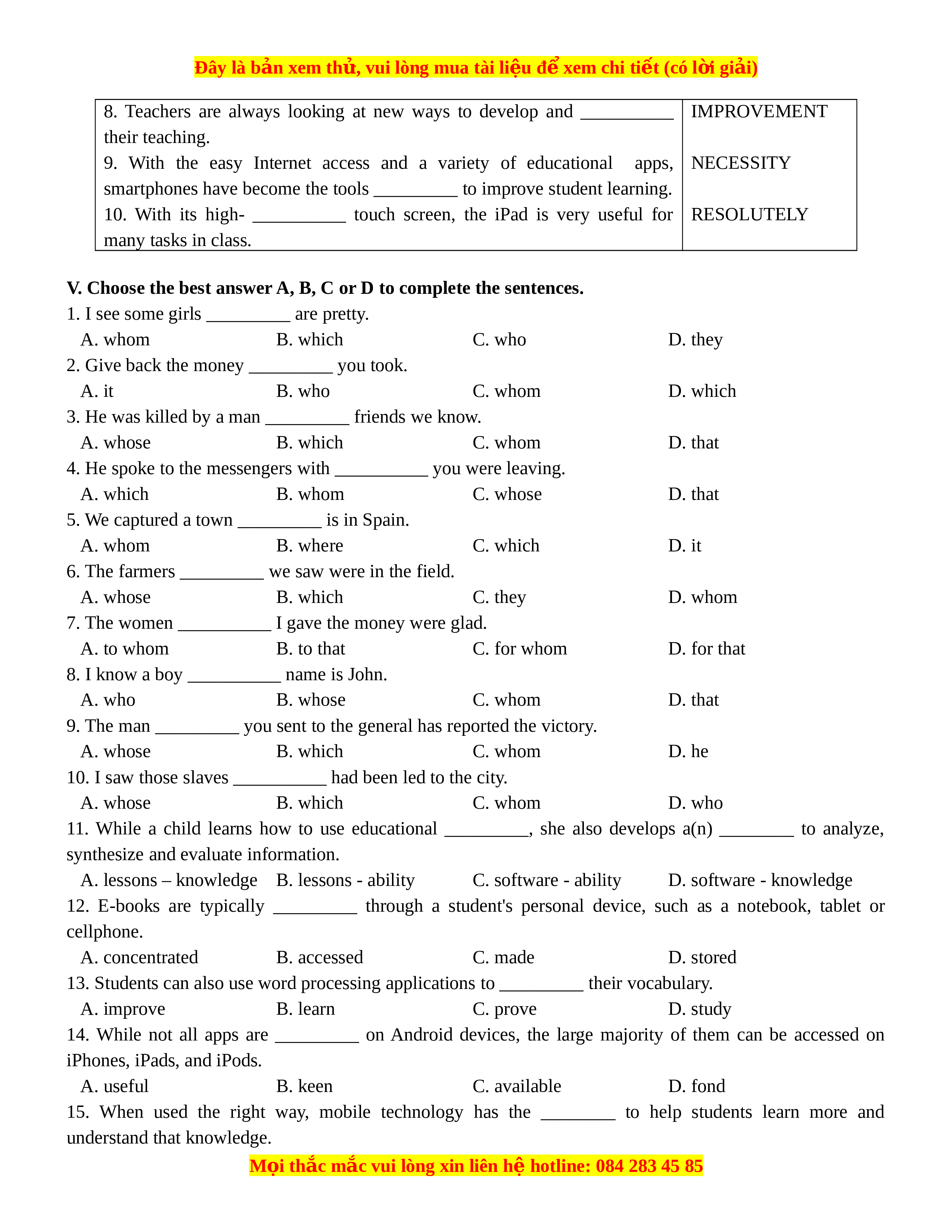
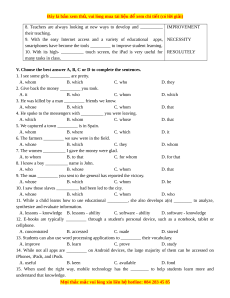
8. Teachers are always looking at new ways to develop and __________
their teaching.
9. With the easy Internet access and a variety of educational apps,
smartphones have become the tools _________ to improve student learning.
10. With its high- __________ touch screen, the iPad is very useful for
many tasks in class.
IMPROVEMENT
NECESSITY
RESOLUTELY
V. Choose the best answer A, B, C or D to complete the sentences.
1. I see some girls _________ are pretty.
A. whom B. which C. who D. they
2. Give back the money _________ you took.
A. it B. who C. whom D. which
3. He was killed by a man _________ friends we know.
A. whose B. which C. whom D. that
4. He spoke to the messengers with __________ you were leaving.
A. which B. whom C. whose D. that
5. We captured a town _________ is in Spain.
A. whom B. where C. which D. it
6. The farmers _________ we saw were in the field.
A. whose B. which C. they D. whom
7. The women __________ I gave the money were glad.
A. to whom B. to that C. for whom D. for that
8. I know a boy __________ name is John.
A. who B. whose C. whom D. that
9. The man _________ you sent to the general has reported the victory.
A. whose B. which C. whom D. he
10. I saw those slaves __________ had been led to the city.
A. whose B. which C. whom D. who
11. While a child learns how to use educational _________, she also develops a(n) ________ to analyze,
synthesize and evaluate information.
A. lessons – knowledge B. lessons - ability C. software - ability D. software - knowledge
12. E-books are typically _________ through a student's personal device, such as a notebook, tablet or
cellphone.
A. concentrated B. accessed C. made D. stored
13. Students can also use word processing applications to _________ their vocabulary.
A. improve B. learn C. prove D. study
14. While not all apps are _________ on Android devices, the large majority of them can be accessed on
iPhones, iPads, and iPods.
A. useful B. keen C. available D. fond
15. When used the right way, mobile technology has the ________ to help students learn more and
understand that knowledge.
M iọ th c m c vui lòng xin liên hắ ắ ệ hotline: 084 283 45 85

 Nhắn tin Zalo