




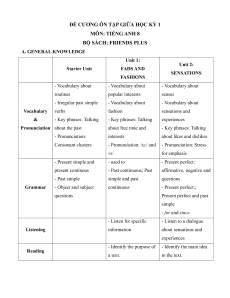
ĐỀ CƯƠNG ÔN TẬP GIỮA HỌC KỲ 1 MÔN: TIẾNG ANH 8
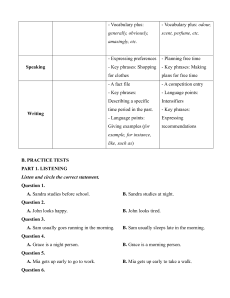
BỘ SÁCH: FRIENDS PLUS A. GENERAL KNOWLEDGE Unit 1: Unit 2: Starter Unit FADS AND SENSATIONS FASHIONS - Vocabulary about - Vocabulary about - Vocabulary about routines popular interests senses - Irregular past simple - Vocabulary about - Vocabulary about Vocabulary verbs fashion sensations and & - Key phrases: Talking - Key phrases: Talking experiences
Pronunciation about the past about free time and - Key phrases: Talking - Pronunciation: interests about likes and dislikes Consonant clusters
- Pronunciation: /u:/ and - Pronunciation: Stress /ʊ/ for emphasis - Present simple and - used to - Present perfect: present continous - Past continuous; Past affirmative, negative and - Past simple simple and past questions Grammar - Object and subject continuous - Present perfect:; questions Present perfect and past simple - for and since - Listen for specific - Listen to a dialogue Listening information about sensations and experiences
- Identify the purpose of - Identify the main idea Reading a text. in the text. - Vocabulary plus:
- Vocabulary plus: odour, generally, obviously, scent, perfume, etc. amazingly, etc.
- Expressing preferences - Planning free time Speaking
- Key phrases: Shopping - Key phrases: Making for clothes plans for free time - A fact file - A competition entry - Key phrases: - Language points: Describing a specific Intensifiers time period in the past. - Key phrases: Writing - Language points: Expressing Giving examples (for recommendations example, for instance, like, such as) B. PRACTICE TESTS PART 1. LISTENING
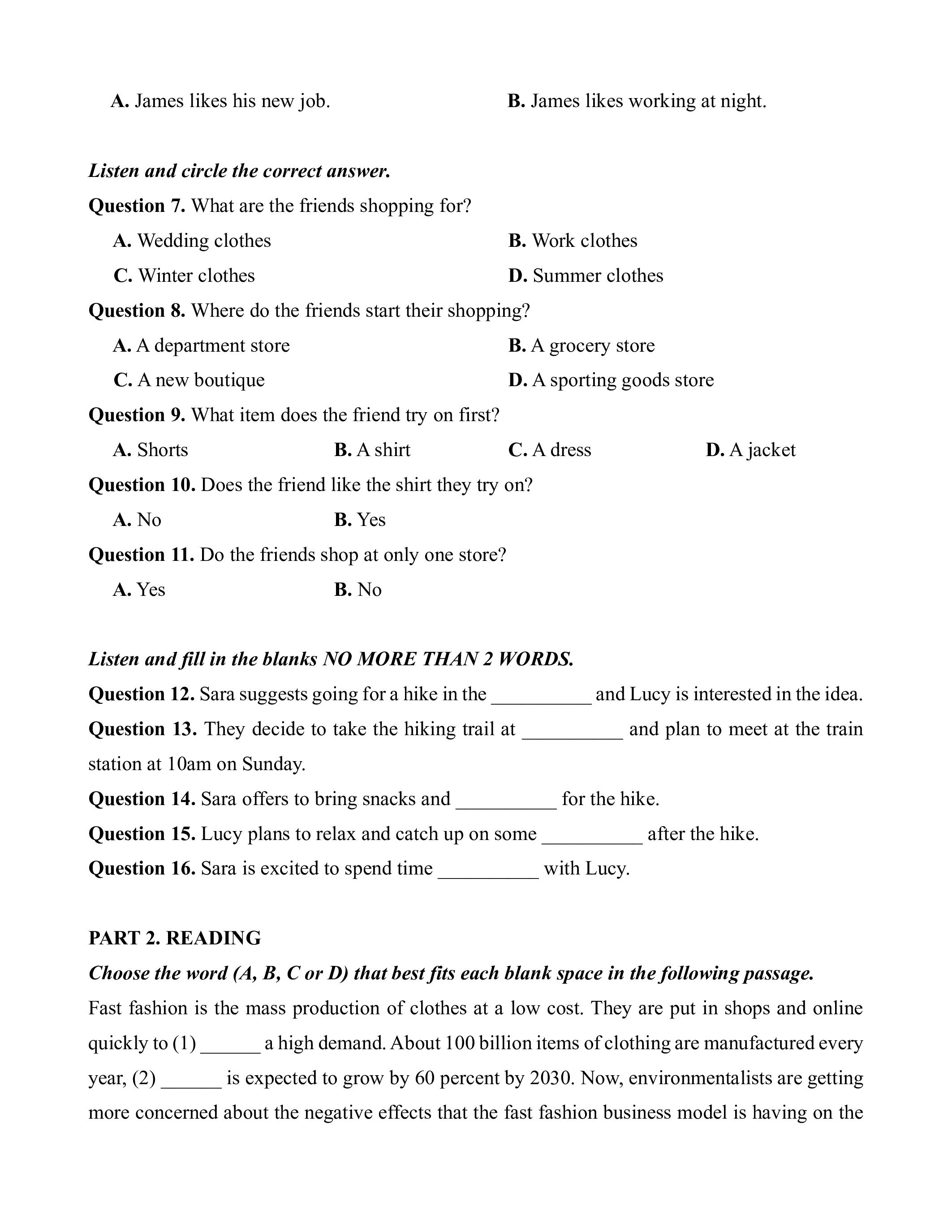
Listen and circle the correct statement. Question 1.
A. Sandra studies before school.
B. Sandra studies at night. Question 2. A. John looks happy.
B. John looks tired. Question 3.
A. Sam usually goes running in the morning.
B. Sam usually sleeps late in the morning. Question 4.
A. Grace is a night person.
B. Grace is a morning person. Question 5.
A. Mia gets up early to go to work.
B. Mia gets up early to take a walk. Question 6.
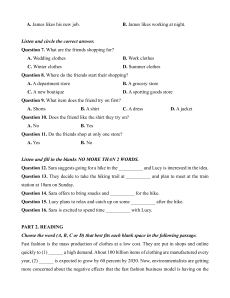
A. James likes his new job.
B. James likes working at night.
Listen and circle the correct answer.
Question 7. What are the friends shopping for? A. Wedding clothes B. Work clothes C. Winter clothes D. Summer clothes
Question 8. Where do the friends start their shopping?
A. A department store B. A grocery store C. A new boutique
D. A sporting goods store
Question 9. What item does the friend try on first? A. Shorts B. A shirt C. A dress D. A jacket
Question 10. Does the friend like the shirt they try on? A. No B. Yes
Question 11. Do the friends shop at only one store? A. Yes B. No
Listen and fill in the blanks NO MORE THAN 2 WORDS.
Question 12. Sara suggests going for a hike in the __________ and Lucy is interested in the idea.
Question 13. They decide to take the hiking trail at __________ and plan to meet at the train station at 10am on Sunday.
Question 14. Sara offers to bring snacks and __________ for the hike.
Question 15. Lucy plans to relax and catch up on some __________ after the hike.
Question 16. Sara is excited to spend time __________ with Lucy. PART 2. READING
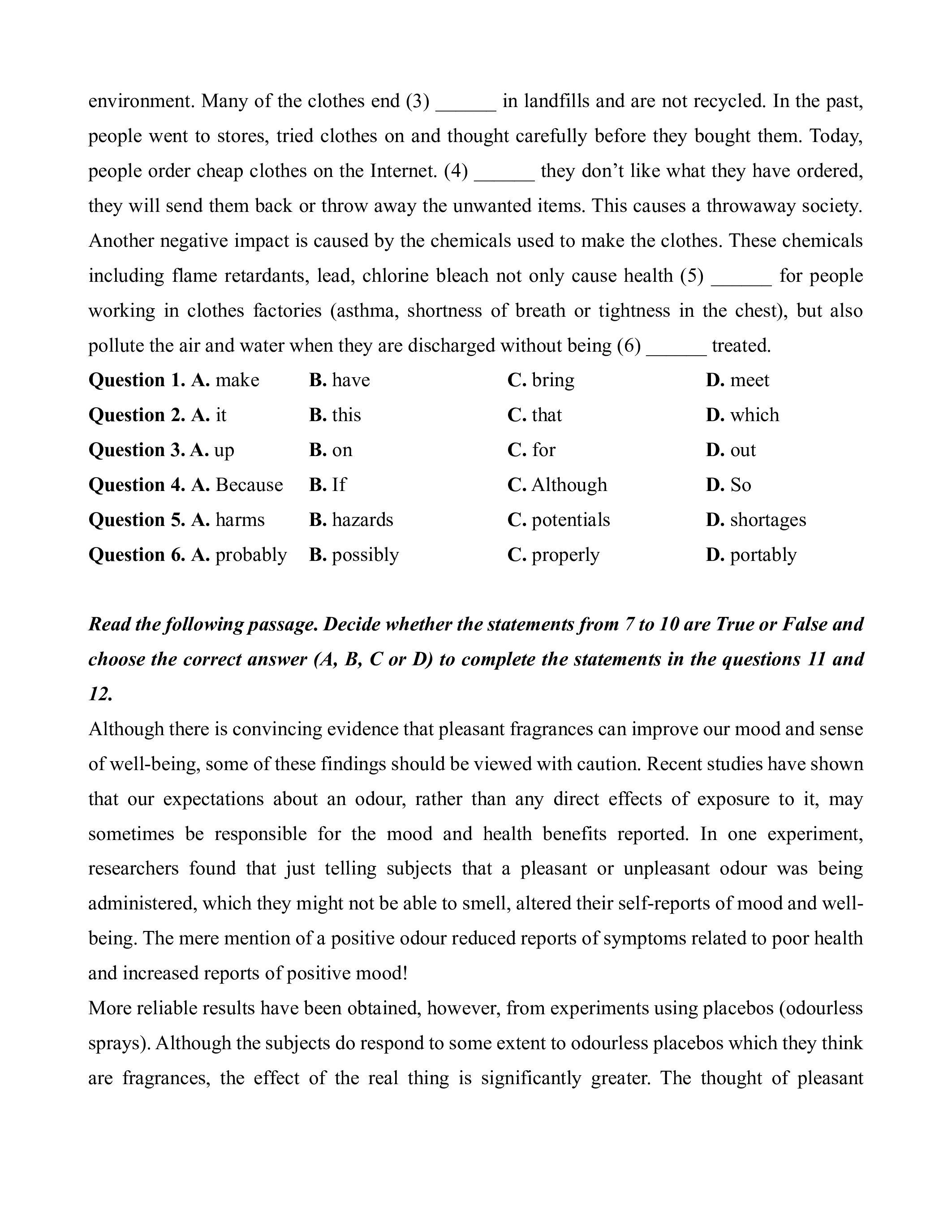
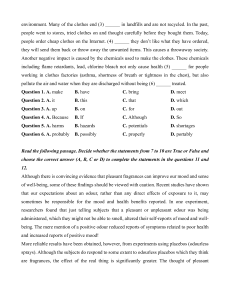
Choose the word (A, B, C or D) that best fits each blank space in the following passage.
Fast fashion is the mass production of clothes at a low cost. They are put in shops and online
quickly to (1) ______ a high demand. About 100 billion items of clothing are manufactured every
year, (2) ______ is expected to grow by 60 percent by 2030. Now, environmentalists are getting
more concerned about the negative effects that the fast fashion business model is having on the
environment. Many of the clothes end (3) ______ in landfills and are not recycled. In the past,
people went to stores, tried clothes on and thought carefully before they bought them. Today,
people order cheap clothes on the Internet. (4) ______ they don’t like what they have ordered,
they will send them back or throw away the unwanted items. This causes a throwaway society.
Another negative impact is caused by the chemicals used to make the clothes. These chemicals
including flame retardants, lead, chlorine bleach not only cause health (5) ______ for people
working in clothes factories (asthma, shortness of breath or tightness in the chest), but also
pollute the air and water when they are discharged without being (6) ______ treated.
Question 1. A. make B. have C. bring D. meet
Question 2. A. it B. this C. that D. which Question 3. A. up B. on C. for D. out
Question 4. A. Because B. If C. Although D. So
Question 5. A. harms B. hazards C. potentials D. shortages
Question 6. A. probably B. possibly C. properly D. portably
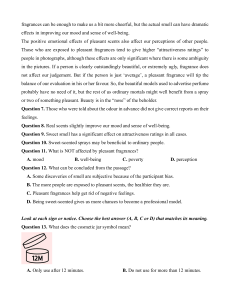
Read the following passage. Decide whether the statements from 7 to 10 are True or False and
choose the correct answer (A, B, C or D) to complete the statements in the questions 11 and 12.
Although there is convincing evidence that pleasant fragrances can improve our mood and sense
of well-being, some of these findings should be viewed with caution. Recent studies have shown
that our expectations about an odour, rather than any direct effects of exposure to it, may
sometimes be responsible for the mood and health benefits reported. In one experiment,
researchers found that just telling subjects that a pleasant or unpleasant odour was being
administered, which they might not be able to smell, altered their self-reports of mood and well-
being. The mere mention of a positive odour reduced reports of symptoms related to poor health
and increased reports of positive mood!
More reliable results have been obtained, however, from experiments using placebos (odourless
sprays). Although the subjects do respond to some extent to odourless placebos which they think
are fragrances, the effect of the real thing is significantly greater. The thought of pleasant
Đề cương ôn tập Giữa kì 1 Tiếng Anh 8 Friends Plus
390
195 lượt tải
80.000 ₫
MUA NGAY ĐỂ XEM TOÀN BỘ TÀI LIỆU
CÁCH MUA:
- B1: Gửi phí vào TK:
1133836868- CT TNHH DAU TU VA DV GD VIETJACK - Ngân hàng MB (QR) - B2: Nhắn tin tới Zalo VietJack Official ( nhấn vào đây ) để xác nhận thanh toán và tải tài liệu - giáo án
Liên hệ ngay Hotline hỗ trợ: 084 283 45 85
Chúng tôi đảm bảo đủ số lượng đề đã cam kết hoặc có thể nhiều hơn, tất cả có BẢN WORD, LỜI GIẢI CHI TIẾT và tải về dễ dàng.
Để tải tài liệu gốc về máy bạn click vào nút Tải Xuống ở trên!
- Tailieugiaovien.com.vn giới thiệu bộ Đề cương ôn tập Giữa kì 1 Tiếng Anh 8 Friends Plus có file nghe Tiếng anh 8 mới nhất nhằm giúp Giáo viên có thêm tài liệu tham khảo ra đề thi Tiếng anh lớp 8.
- File word có lời giải chi tiết 100%.
- Mua trọn bộ sẽ tiết kiệm hơn tải lẻ 50%.
Đánh giá
4.6 / 5(390 )5
4
3
2
1

Trọng Bình
Tài liệu hay
Giúp ích cho tôi rất nhiều
Duy Trần
Tài liệu chuẩn
Rất thích tài liệu bên VJ soạn (bám sát chương trình dạy)
TÀI LIỆU BỘ BÁN CHẠY MÔN Tiếng Anh
Xem thêm-
 Bộ 15 đề thi giữa kì 1 Tiếng Anh 8 Global success có đáp án150.000 ₫ - 200.000 ₫ 62.9 K 31.4 K lượt tải
-
 Giáo án điện tử Tiếng Anh 8 Global success250.000 ₫ 3.5 K 1.8 K lượt tải
-
Bài tập Tiếng Anh 8 Global success có đáp án200.000 ₫ 23.5 K 11.7 K lượt tải
-
Bồi dưỡng Học sinh giỏi Tiếng Anh 8 có đáp án mới nhất100.000 ₫ 12.9 K 6.5 K lượt tải
-
Giáo án Tiếng Anh 8 Global success (năng lực số)200.000 ₫ - 250.000 ₫ 14.8 K 7.4 K lượt tải
-
Chuyên đề ôn thi HSG Tiếng Anh 8 (theo dạng bài300.000 ₫ 1.3 K 656 lượt tải
-
Bộ 10 đề thi cuối kì 1 Tiếng Anh 8 Global success có đáp án150.000 ₫ 24.5 K 12.2 K lượt tải
-
Đề cương ôn tập Giữa kì 1 Tiếng Anh 8 Global Success80.000 ₫ 2.4 K 1.2 K lượt tải
TÀI LIỆU BỘ BÁN CHẠY Lớp 8
Xem thêm-
Bộ 64 đề thi giữa kì 1 Toán 8 Kết nối tri thức Cấu trúc mới150.000 ₫ - 200.000 ₫ 97.5 K 48.7 K lượt tải
-
Bộ 25 đề thi giữa kì 1 Ngữ văn 8 Kết nối tri thức Cấu trúc mới150.000 ₫ 53.3 K 26.7 K lượt tải
-
Bài giảng Powerpoint Địa lí 8 Kết nối tri thức250.000 ₫ 9.4 K 4.7 K lượt tải
-
Giáo án Hoạt động trải nghiệm 8 Kết nối tri thức (năng lực số)200.000 ₫ - 250.000 ₫ 4.3 K 2.1 K lượt tải
-
Bộ đề thi giữa kì 1 Địa lí 8 Kết nối tri thức Cấu trúc mới70.000 ₫ 3 K 1.5 K lượt tải
-
Bài giảng Powerpoint Ngữ văn 8 Kết nối tri thức350.000 ₫ 24.7 K 12.3 K lượt tải
-
Bộ đề thi giữa kì 1 Lịch sử 8 Kết nối tri thức Cấu trúc mới70.000 ₫ 4 K 2 K lượt tải
-
Đề cương ôn tập Giữa kì 1 Toán 8 Kết nối tri thức Cấu trúc mới80.000 ₫ 10.6 K 5.3 K lượt tải

 Nhắn tin Zalo