






ệ đ xe ể m chi ti t ế (có l i ờ gi i ả )
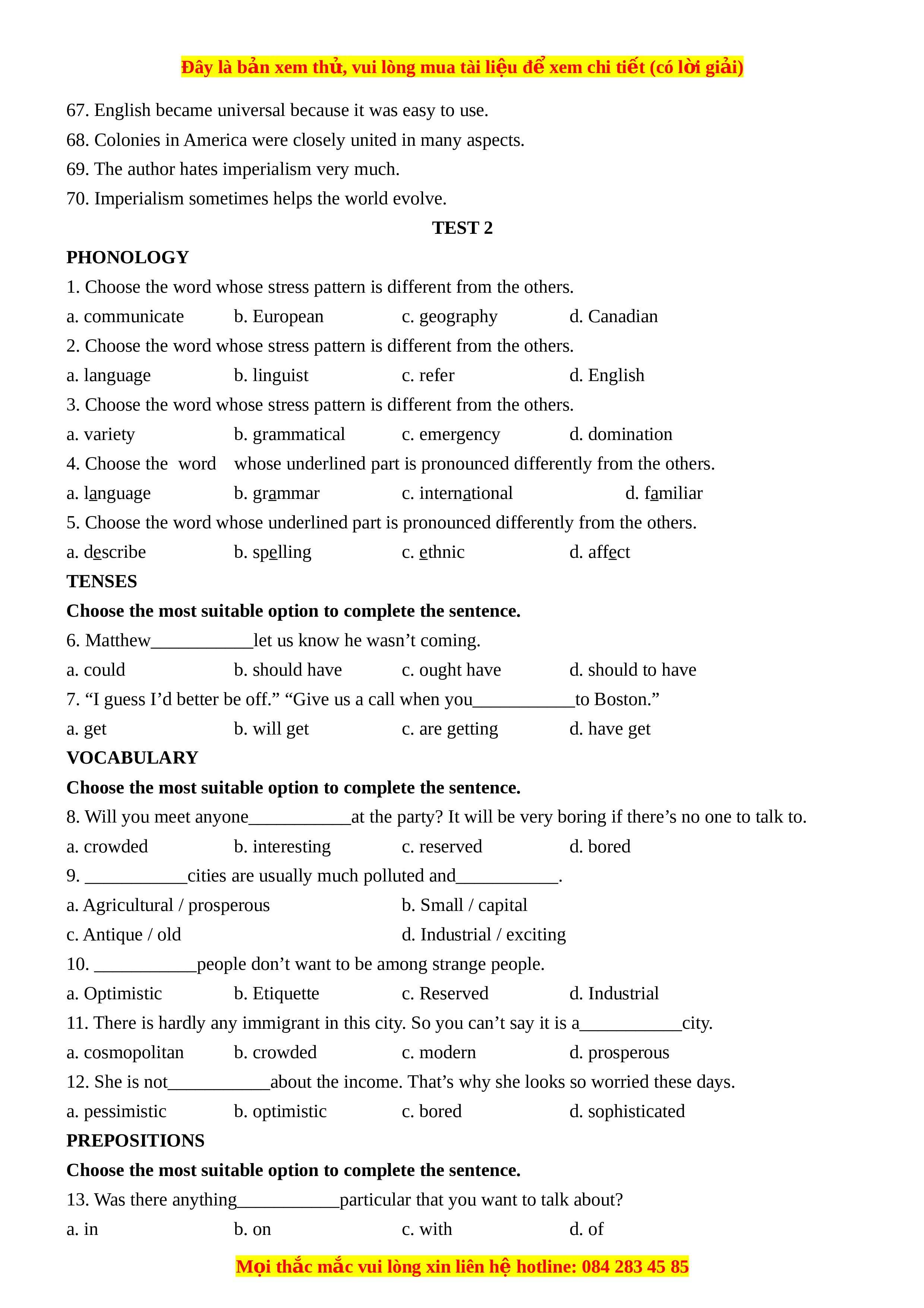
UNIT 16: AN ENGLISH-SPEAKING WORLD TEST 1 I. MULTIPLE CHOICE
Choose the most suitable option to complete the sentence. Tenses
1. “What time are you coming?” “If I__________get away from work early, I’ll be there at five o’clock.” a. could b. may c. will d. can
2. “When is Tom and Sue’s wedding?” “Tom and Sue__________married next week.” a. get b. are getting c. will get d. were getting
3. They__________have the boiler repaired when it stopped working. a. must b. should c. have to d. had to
4. By next week they__________resurfacing the road. a. finish b. will finish c. are finishing d. will have finished
5. “Do you know when the post office opens?” “It__________every day at 8 o’clock.” a. is opening b. will open c. is going to open d. opens Prepositions
6. The application must be written__________English. a. by b. with c. in d. on
7. Afro-Americans account__________12% of the US population. a. for b. with c. of d. ∅
8. Carry__________with the work when I’m away. a. out b. on c. along d. ∅
9. Most people are familiar__________the American form of this adjective. a. of b. in c. away d. with
10. He likes to be referred__________as ‘Doctor Green’. a. by b. on c. to d. with Grammar
11. If you asked politely he__________do you a favor a. will b. can c. might d. does
12. If she__________this company, she would have make a lot of changes. a. runs b. had run c. is running d. ran
13. James owns a restaurant, __________? a. does he b. is he c. doesn’t he d. didn’t he?
14. You aren’t too busy to talk, __________? a. are you b. have you c. aren’t d. do you
15. Let’s invite the Smiths from next door, __________? a. let we b. don’t we c. will you d. shall we Speaking M i
ọ thắc mắc vui lòng xin liên hệ hotline: 084 283 45 85
ệ đ xe ể m chi ti t ế (có l i ờ gi i ả )
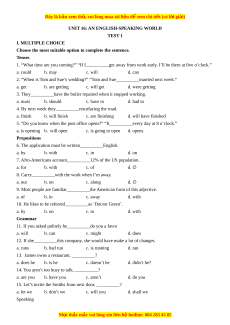
16. ‘The problems seem annoying to everyone.’ - ‘__________.’ a. It is b. They are c. They do d. It is
17. ‘You don’t like wine, do you?’ - ‘__________. I never drink it.’
a. yes, I don’t b. No, I don’t c. Yes, I do d. No, I am not
18. ‘I phoned but you didn’t answer it. You must have gone out.’- ‘__________’. a. I did b. I was c. I must d. I agree
19. ‘David seemed to be very angry.’ - ‘__________.’ a. He did b. He had c. He seemed d. He was
20. ‘You didn’t go to school yesterday, didn’t you?’ - ‘__________. I saw you but I was too busy to talk to you.’ a. Yes, I did b. No, I did c. No, I didn’t d. Yes, I didn’t II. VOCABULARY
Complete each of the following sentences with one of the words provided in the box.
residential the Middle Ages lingua franca European Union feature
mother tongue bustling communicate foreign language
21. When people whose main languages are different meet, they will use a __________such as English.
22. Besides Vietnamese as her__________, she can also use French and English.
23. It is essential that you know a__________. If not, you can hardly __________with foreigners.
24. How many countries belong to the__________?
25. The term ‘__________’ refers to the period in European history between about 1100 and 1500 AD.
26. An important__________of Van Gogh’s paintings is their bright colors.
27. The flower market was__________with shoppers.
28. They prefer to live in a quiet__________neighborhood. III. WORD FORMS
Complete the following sentences with the appropriate forms of the given words.
29. They are very__________ about the future economic__________of the country (optimism - prosperous)
30. The__________language in the USA is American English (dominate)
31. English has been widely used as a means of__________. (communicate)
32. Don’t__________words while speaking and don’t__________words while writing (pronunciation - spelling)
33. Naomi Chomsky is among the leading__________of the world. He has had a lot of citable works
in__________. (language - language)
34. The more__________developed a country is, the more__________it is. (industry — pollute)
35. The 1950s saw the__________of Japan as a world leader (emerge)
36. Economic__________affects the life of all people (depress) IV. CLOZE TEST
Fill in each blank with one suitable word to make a complete passage. M i
ọ thắc mắc vui lòng xin liên hệ hotline: 084 283 45 85
ệ đ xe ể m chi ti t ế (có l i ờ gi i ả )
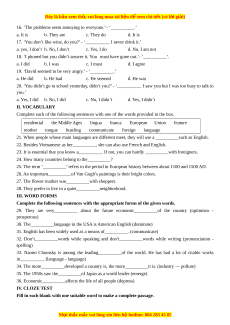
The word Anglo sphere describes a group of Anglophone (English-speaking) (37) __________ which
share historical, political, and cultural characteristics rooted in or attributed to the historical experience of
the (38) __________Kingdom. The Anglo sphere (39) __________those former colonies and dominions
of the UK (40) __________English is the main language and Christianity is the main (41) __________.
The term is usually attributed to science (42)__________writer Neal Stephenson, used in his 1995 novel
The Diamond Age. Its first published use after this was in an article by James c. Bennett entitled
“Canada’s World Advantage” which appeared in a Canadian (43) __________The National Post, on 4
January 2000 (page A16). The term “Anglophone” is rarely used, usually in contradistinction to
Francophone, but is more (44) __________in other languages. V. SENTENCE TRANSFORMATION
Rewrite the following sentences with the given beginning so that the meaning remains unchanged.
45. It may rain and you should bring this umbrella.
→ In case ___________________________________
46. The baby didn’t cry, so we had a good sleep.
→ If___________________________________
47. What a pity we didn’t buy the picture! We can’t make money from it.
→ If___________________________________
48. She didn’t go on holiday because she didn’t have enough money.
→ If she___________________________________
49. Mr. Mills lost his job because he was late every day.
→ If Mr. Mills ___________________________________
50. John will stay on at school unless he finds a good job before September.
→ If___________________________________
51. John missed the ferry because his car broke down.
→ If ___________________________________
52. John is fat because he eats so many chips.
→ If___________________________________
53. You pay for your own meals and you can go with us.
→ Provided: ___________________________________'
54. I’m not rich and I have to do this boring thing.
→ Were___________________________________ VI. SENTENCE BUILDING
Use the given cues to make complete sentences.
55. one / barriers / international understanding / be / everyone / not speak / common language
→ __________________________________________________
56. differences / languages / separate / peoples recently
→ __________________________________________________
57. world / need / common language / open the door / better international understanding
→ __________________________________________________ M i
ọ thắc mắc vui lòng xin liên hệ hotline: 084 283 45 85
ệ đ xe ể m chi ti t ế (có l i ờ gi i ả )
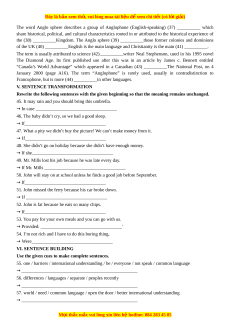
58. English seem / biggest chance / become / international language / though / second / Chinese / number / speakers
→ __________________________________________________
59. it / say / English belong / world because / speak / second language / more non-English speaking people
→ __________________________________________________
60. English / most useful language / business, science, air traffic control / international sports
→ __________________________________________________
61. more / written / English /every field / life
→ __________________________________________________
62. there /English newspapers / almost all / important cities / world
→ __________________________________________________ VII. READING COMPREHENSION
Read the following passage and decide whether the statements are True or False.
During the history of mankind, there have been several more or less universal languages or lingua
francas, such as Latin (and Greek) in the Roman empire, mediaeval Latin in Western Europe, later French
and English. Universality is of course relative; it means universality in the “known world” or “civilized
world”, or just in a large empire. No language has been really universal (global), but the current position
of English comes closest. The position of a universal language has always been gained as a by-product of
some sort of imperialism: a nation has conquered a large area and more or less assimilated it into its own
culture, including language, thus forming an empire. Usually the language of the conqueror has become
the language of the state and the upper class first, then possibly spread over the society, sometimes almost
wiping out the original languages of the conquered areas. Sometimes - especially in the Middle Ages - the
imperialism has had a definite cultural and religious nature which may have been more important than
brute military and economic force.
As regards to the English language, it would have remained as a national language of the English, had it
not happened so that the English first conquered the rest of the British Isles, then many other parts of the
world. Later, some English colonies in a relatively small part of America rebelled, formed the United
States of America, and expanded a lot. They formed a federal state where a variant of the English
language was one of the few really uniting factors. And that federal state became, as we all know, wealthy
and important. It also exercised traditional imperialism, but more importantly it gained a very important
role in world economy and politics. Whether you call the US influence imperialism or neo-imperialism is
a matter of opinion, but it certainly has similar effects on maintaining and expanding the use of English as classical imperialism.
This probably sounds like political criticism, but it is intended to be descriptive only. Personally, I do not
regard imperialism as an incarnation of the Evil; it has had both positive and negative effects, and in
many cases imperialism has been a necessary step from chaos to civilization.
63. English is the first universal language of human beings.
64. English has more speakers than Latin, Greek and French did.
65. The position of universal language comes along with imperialism.
66. Cultural influence benefits conquerors even more than military or economic force. M i
ọ thắc mắc vui lòng xin liên hệ hotline: 084 283 45 85
Trắc nghiệm nâng cao Unit 16: An english-speaking world Tiếng Anh 11 - Mai Lan Hương
364
182 lượt tải
0 ₫
MUA NGAY ĐỂ XEM TOÀN BỘ TÀI LIỆU
CÁCH MUA:
- B1: Gửi phí vào TK:
1133836868- CT TNHH DAU TU VA DV GD VIETJACK - Ngân hàng MB (QR) - B2: Nhắn tin tới Zalo VietJack Official ( nhấn vào đây ) để xác nhận thanh toán và tải tài liệu - giáo án
Liên hệ ngay Hotline hỗ trợ: 084 283 45 85
Tài liệu được cập nhật liên tục trong gói này từ nay đến hết tháng 6/2023. Chúng tôi đảm bảo đủ số lượng đề đã cam kết hoặc có thể nhiều hơn, tất cả có BẢN WORD, LỜI GIẢI CHI TIẾT và tải về dễ dàng.
Để tải tài liệu gốc về máy bạn click vào nút Tải Xuống ở trên!
Thuộc bộ (mua theo bộ để tiết kiệm hơn):
- Tailieugiaovien.com.vn giới thiệu Bộ bài tập trắc nghiệm nâng cao Tiếng Anh lớp 11 biên soạn bởi GV Mai Lan Hương mới nhất nhằm giúp Giáo viên có thêm tài liệu tham khảo bài tập Tiếng Anh lớp 11.
- File word có lời giải chi tiết 100%.
- Mua trọn bộ sẽ tiết kiệm hơn tải lẻ 50%.
Đánh giá
4.6 / 5(364 )5
4
3
2
1

Trọng Bình
Tài liệu hay
Giúp ích cho tôi rất nhiều
Duy Trần
Tài liệu chuẩn
Rất thích tài liệu bên VJ soạn (bám sát chương trình dạy)
TÀI LIỆU BỘ BÁN CHẠY MÔN Tiếng Anh
Xem thêm-
 Bài giảng Powerpoint Tiếng Anh 11 Global success300.000 ₫ 3.9 K 2 K lượt tải
-
 Giáo án Tiếng Anh 11 Global success (năng lực số)200.000 ₫ - 250.000 ₫ 15.7 K 7.9 K lượt tải
-
Bộ 20 đề thi HSG Tiếng Anh 11 có đáp án300.000 ₫ 618 309 lượt tải
-
Bộ 23 đề thi giữa kì 1 Tiếng Anh 11 Global success có đáp án150.000 ₫ 17.8 K 8.9 K lượt tải
-
Bộ 15 đề thi cuối kì 1 Tiếng Anh 11 Global success có đáp án150.000 ₫ 11.4 K 5.7 K lượt tải
-
Bài tập phát triển kĩ năng Tiếng Anh 11 Global success100.000 ₫ 1.7 K 856 lượt tải
-
Đề cương ôn tập Cuối kì 2 Tiếng Anh 11 Global succes80.000 ₫ 550 275 lượt tải
-
5 Đề khảo soát chất lượng đầu năm 2024-2025 Tiếng Anh 11 có lời giải90.000 ₫ 1.1 K 571 lượt tải
TÀI LIỆU BỘ BÁN CHẠY Lớp 11
Xem thêm-
Bài giảng Powerpoint Lịch sử 11 Kết nối tri thức250.000 ₫ 14.3 K 7.1 K lượt tải
-
Bài giảng Powerpoint Địa lí 11 Kết nối tri thức250.000 ₫ 10.7 K 5.3 K lượt tải
-
Bài giảng Powerpoint KTPL 11 Kết nối tri thức200.000 ₫ 7.7 K 3.9 K lượt tải
-
Giáo án Hoạt động trải nghiệm 11 Kết nối tri thức (năng lực số)200.000 ₫ - 250.000 ₫ 2.3 K 1.1 K lượt tải
-
Bộ 96 đề thi giữa kì 1 Toán 11 Kết nối tri thức Cấu trúc mới150.000 ₫ - 200.000 ₫ 31.3 K 15.7 K lượt tải
-
Bài giảng Powerpoint Ngữ văn 11 Kết nối tri thức350.000 ₫ 9.2 K 4.6 K lượt tải
-
Đề cương ôn tập giữa kì 1 Toán 11 Kết nối tri thức cấu trúc mới80.000 ₫ 2.3 K 1.2 K lượt tải
-
Giáo án Lịch sử 11 Kết nối tri thức (năng lực số)200.000 ₫ - 250.000 ₫ 6.6 K 3.3 K lượt tải
Tài liệu bộ mới nhất

Đây là b nả xem thử, vui lòng mua tài li u đ xem chi ti t (có l i gi i)ệ ể ế ờ ả
UNIT 16: AN ENGLISH-SPEAKING WORLD
TEST 1
I. MULTIPLE CHOICE
Choose the most suitable option to complete the sentence.
Tenses
1. “What time are you coming?” “If I__________get away from work early, I’ll be there at five o’clock.”
a. could b. may c. will d. can
2. “When is Tom and Sue’s wedding?” “Tom and Sue__________married next week.”
a. get b. are getting c. will get d. were getting
3. They__________have the boiler repaired when it stopped working.
a. must b. should c. have to d. had to
4. By next week they__________resurfacing the road.
a. finish b. will finish c. are finishing d. will have finished
5. “Do you know when the post office opens?” “It__________every day at 8 o’clock.”
a. is opening b. will open c. is going to open d. opens
Prepositions
6. The application must be written__________English.
a. by b. with c. in d. on
7. Afro-Americans account__________12% of the US population.
a. for b. with c. of d. ∅
8. Carry__________with the work when I’m away.
a. out b. on c. along d. ∅
9. Most people are familiar__________the American form of this adjective.
a. of b. in c. away d. with
10. He likes to be referred__________as ‘Doctor Green’.
a. by b. on c. to d. with
Grammar
11. If you asked politely he__________do you a favor
a. will b. can c. might d. does
12. If she__________this company, she would have make a lot of changes.
a. runs b. had run c. is running d. ran
13. James owns a restaurant, __________?
a. does he b. is he c. doesn’t he d. didn’t he?
14. You aren’t too busy to talk, __________?
a. are you b. have you c. aren’t d. do you
15. Let’s invite the Smiths from next door, __________?
a. let we b. don’t we c. will you d. shall we
Speaking
M iọ th c m c vui lòng xin liên hắ ắ ệ hotline: 084 283 45 85

Đây là b nả xem thử, vui lòng mua tài li u đ xem chi ti t (có l i gi i)ệ ể ế ờ ả
16. ‘The problems seem annoying to everyone.’ - ‘__________.’
a. It is b. They are c. They do d. It is
17. ‘You don’t like wine, do you?’ - ‘__________. I never drink it.’
a. yes, I don’t b. No, I don’t c. Yes, I do d. No, I am not
18. ‘I phoned but you didn’t answer it. You must have gone out.’- ‘__________’.
a. I did b. I was c. I must d. I agree
19. ‘David seemed to be very angry.’ - ‘__________.’
a. He did b. He had c. He seemed d. He was
20. ‘You didn’t go to school yesterday, didn’t you?’ - ‘__________. I saw you but I was too busy to talk to
you.’
a. Yes, I did b. No, I did c. No, I didn’t d. Yes, I didn’t
II. VOCABULARY
Complete each of the following sentences with one of the words provided in the box.
residential the Middle Ages lingua franca European Union feature
mother tongue bustling communicate foreign language
21. When people whose main languages are different meet, they will use a __________such as English.
22. Besides Vietnamese as her__________, she can also use French and English.
23. It is essential that you know a__________. If not, you can hardly __________with foreigners.
24. How many countries belong to the__________?
25. The term ‘__________’ refers to the period in European history between about 1100 and 1500 AD.
26. An important__________of Van Gogh’s paintings is their bright colors.
27. The flower market was__________with shoppers.
28. They prefer to live in a quiet__________neighborhood.
III. WORD FORMS
Complete the following sentences with the appropriate forms of the given words.
29. They are very__________ about the future economic__________of the country (optimism -
prosperous)
30. The__________language in the USA is American English (dominate)
31. English has been widely used as a means of__________. (communicate)
32. Don’t__________words while speaking and don’t__________words while writing (pronunciation -
spelling)
33. Naomi Chomsky is among the leading__________of the world. He has had a lot of citable works
in__________. (language - language)
34. The more__________developed a country is, the more__________it is. (industry — pollute)
35. The 1950s saw the__________of Japan as a world leader (emerge)
36. Economic__________affects the life of all people (depress)
IV. CLOZE TEST
Fill in each blank with one suitable word to make a complete passage.
M iọ th c m c vui lòng xin liên hắ ắ ệ hotline: 084 283 45 85

Đây là b nả xem thử, vui lòng mua tài li u đ xem chi ti t (có l i gi i)ệ ể ế ờ ả
The word Anglo sphere describes a group of Anglophone (English-speaking) (37) __________ which
share historical, political, and cultural characteristics rooted in or attributed to the historical experience of
the (38) __________Kingdom. The Anglo sphere (39) __________those former colonies and dominions
of the UK (40) __________English is the main language and Christianity is the main (41) __________.
The term is usually attributed to science (42)__________writer Neal Stephenson, used in his 1995 novel
The Diamond Age. Its first published use after this was in an article by James c. Bennett entitled
“Canada’s World Advantage” which appeared in a Canadian (43) __________The National Post, on 4
January 2000 (page A16). The term “Anglophone” is rarely used, usually in contradistinction to
Francophone, but is more (44) __________in other languages.
V. SENTENCE TRANSFORMATION
Rewrite the following sentences with the given beginning so that the meaning remains unchanged.
45. It may rain and you should bring this umbrella.
→ In case ___________________________________
46. The baby didn’t cry, so we had a good sleep.
→ If___________________________________
47. What a pity we didn’t buy the picture! We can’t make money from it.
→ If___________________________________
48. She didn’t go on holiday because she didn’t have enough money.
→ If she___________________________________
49. Mr. Mills lost his job because he was late every day.
→ If Mr. Mills ___________________________________
50. John will stay on at school unless he finds a good job before September.
→ If___________________________________
51. John missed the ferry because his car broke down.
→ If ___________________________________
52. John is fat because he eats so many chips.
→ If___________________________________
53. You pay for your own meals and you can go with us.
→ Provided: ___________________________________'
54. I’m not rich and I have to do this boring thing.
→ Were___________________________________
VI. SENTENCE BUILDING
Use the given cues to make complete sentences.
55. one / barriers / international understanding / be / everyone / not speak / common language
→ __________________________________________________
56. differences / languages / separate / peoples recently
→ __________________________________________________
57. world / need / common language / open the door / better international understanding
→ __________________________________________________
M iọ th c m c vui lòng xin liên hắ ắ ệ hotline: 084 283 45 85

Đây là b nả xem thử, vui lòng mua tài li u đ xem chi ti t (có l i gi i)ệ ể ế ờ ả
58. English seem / biggest chance / become / international language / though / second / Chinese /
number / speakers
→ __________________________________________________
59. it / say / English belong / world because / speak / second language / more non-English speaking
people
→ __________________________________________________
60. English / most useful language / business, science, air traffic control / international sports
→ __________________________________________________
61. more / written / English /every field / life
→ __________________________________________________
62. there /English newspapers / almost all / important cities / world
→ __________________________________________________
VII. READING COMPREHENSION
Read the following passage and decide whether the statements are True or False.
During the history of mankind, there have been several more or less universal languages or lingua
francas, such as Latin (and Greek) in the Roman empire, mediaeval Latin in Western Europe, later French
and English. Universality is of course relative; it means universality in the “known world” or “civilized
world”, or just in a large empire. No language has been really universal (global), but the current position
of English comes closest. The position of a universal language has always been gained as a by-product of
some sort of imperialism: a nation has conquered a large area and more or less assimilated it into its own
culture, including language, thus forming an empire. Usually the language of the conqueror has become
the language of the state and the upper class first, then possibly spread over the society, sometimes almost
wiping out the original languages of the conquered areas. Sometimes - especially in the Middle Ages - the
imperialism has had a definite cultural and religious nature which may have been more important than
brute military and economic force.
As regards to the English language, it would have remained as a national language of the English, had it
not happened so that the English first conquered the rest of the British Isles, then many other parts of the
world. Later, some English colonies in a relatively small part of America rebelled, formed the United
States of America, and expanded a lot. They formed a federal state where a variant of the English
language was one of the few really uniting factors. And that federal state became, as we all know, wealthy
and important. It also exercised traditional imperialism, but more importantly it gained a very important
role in world economy and politics. Whether you call the US influence imperialism or neo-imperialism is
a matter of opinion, but it certainly has similar effects on maintaining and expanding the use of English as
classical imperialism.
This probably sounds like political criticism, but it is intended to be descriptive only. Personally, I do not
regard imperialism as an incarnation of the Evil; it has had both positive and negative effects, and in
many cases imperialism has been a necessary step from chaos to civilization.
63. English is the first universal language of human beings.
64. English has more speakers than Latin, Greek and French did.
65. The position of universal language comes along with imperialism.
66. Cultural influence benefits conquerors even more than military or economic force.
M iọ th c m c vui lòng xin liên hắ ắ ệ hotline: 084 283 45 85

Đây là b nả xem thử, vui lòng mua tài li u đ xem chi ti t (có l i gi i)ệ ể ế ờ ả
67. English became universal because it was easy to use.
68. Colonies in America were closely united in many aspects.
69. The author hates imperialism very much.
70. Imperialism sometimes helps the world evolve.
TEST 2
PHONOLOGY
1. Choose the word whose stress pattern is different from the others.
a. communicate b. European c. geography d. Canadian
2. Choose the word whose stress pattern is different from the others.
a. language b. linguist c. refer d. English
3. Choose the word whose stress pattern is different from the others.
a. variety b. grammatical c. emergency d. domination
4. Choose the word whose underlined part is pronounced differently from the others.
a. language b. grammar c. international d. familiar
5. Choose the word whose underlined part is pronounced differently from the others.
a. describe b. spelling c. ethnic d. affect
TENSES
Choose the most suitable option to complete the sentence.
6. Matthew___________let us know he wasn’t coming.
a. could b. should have c. ought have d. should to have
7. “I guess I’d better be off.” “Give us a call when you___________to Boston.”
a. get b. will get c. are getting d. have get
VOCABULARY
Choose the most suitable option to complete the sentence.
8. Will you meet anyone___________at the party? It will be very boring if there’s no one to talk to.
a. crowded b. interesting c. reserved d. bored
9. ___________cities are usually much polluted and___________.
a. Agricultural / prosperous b. Small / capital
c. Antique / old d. Industrial / exciting
10. ___________people don’t want to be among strange people.
a. Optimistic b. Etiquette c. Reserved d. Industrial
11. There is hardly any immigrant in this city. So you can’t say it is a___________city.
a. cosmopolitan b. crowded c. modern d. prosperous
12. She is not___________about the income. That’s why she looks so worried these days.
a. pessimistic b. optimistic c. bored d. sophisticated
PREPOSITIONS
Choose the most suitable option to complete the sentence.
13. Was there anything___________particular that you want to talk about?
a. in b. on c. with d. of
M iọ th c m c vui lòng xin liên hắ ắ ệ hotline: 084 283 45 85

 Nhắn tin Zalo