






ệ đ xe ể m chi ti t ế (có l i ờ gi i ả )
UNIT 4: VOLUNTEER WORK AND LITERACY PROGRAMS TEST 1 I. MULTIPLE CHOICE
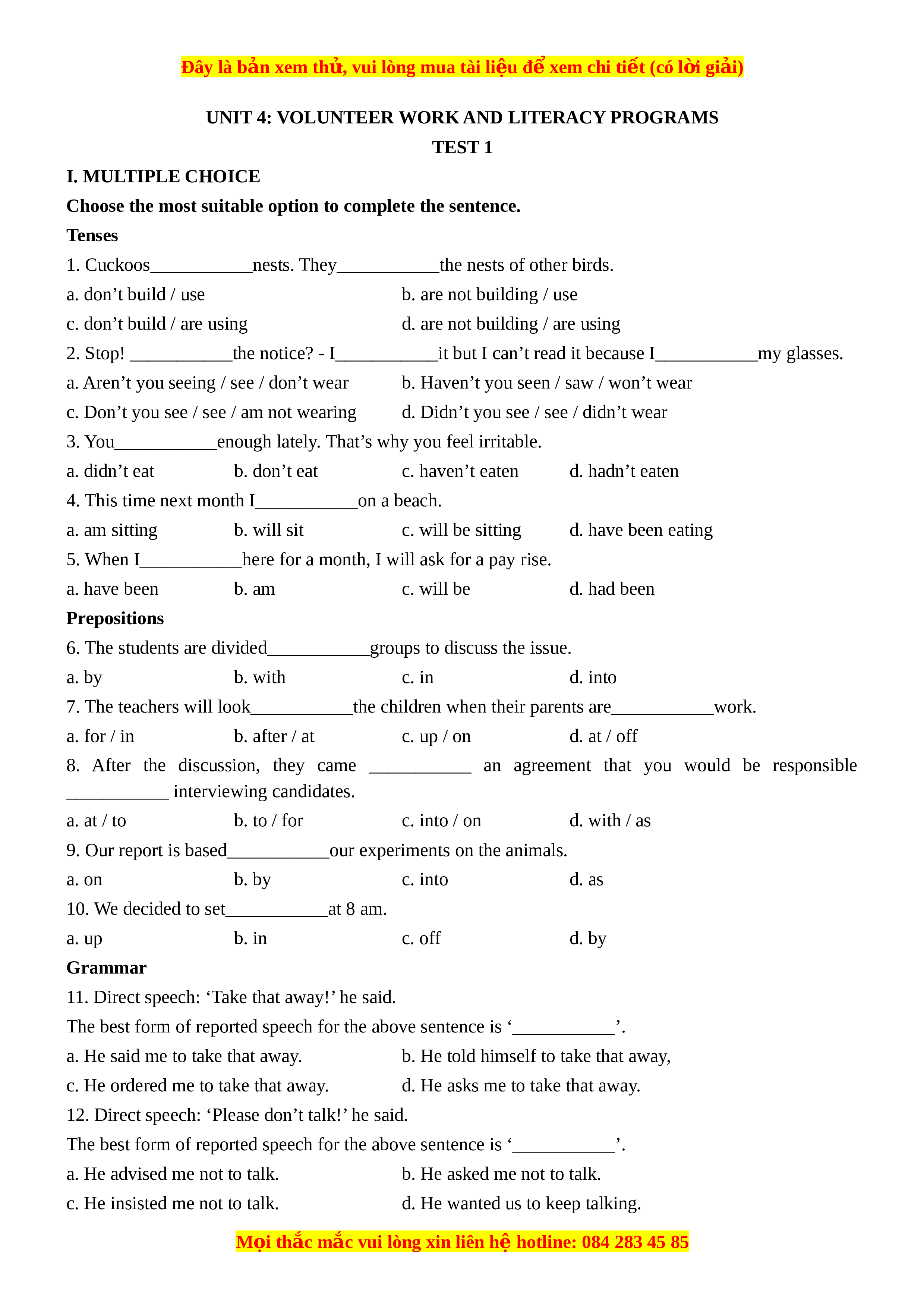
Choose the most suitable option to complete the sentence. Tenses
1. Cuckoos___________nests. They___________the nests of other birds. a. don’t build / use b. are not building / use c. don’t build / are using
d. are not building / are using
2. Stop! ___________the notice? - I___________it but I can’t read it because I___________my glasses.
a. Aren’t you seeing / see / don’t wear
b. Haven’t you seen / saw / won’t wear
c. Don’t you see / see / am not wearing
d. Didn’t you see / see / didn’t wear
3. You___________enough lately. That’s why you feel irritable. a. didn’t eat b. don’t eat c. haven’t eaten d. hadn’t eaten
4. This time next month I___________on a beach. a. am sitting b. will sit c. will be sitting d. have been eating
5. When I___________here for a month, I will ask for a pay rise. a. have been b. am c. will be d. had been Prepositions
6. The students are divided___________groups to discuss the issue. a. by b. with c. in d. into
7. The teachers will look___________the children when their parents are___________work. a. for / in b. after / at c. up / on d. at / off
8. After the discussion, they came ___________ an agreement that you would be responsible
___________ interviewing candidates. a. at / to b. to / for c. into / on d. with / as
9. Our report is based___________our experiments on the animals. a. on b. by c. into d. as
10. We decided to set___________at 8 am. a. up b. in c. off d. by Grammar
11. Direct speech: ‘Take that away!’ he said.
The best form of reported speech for the above sentence is ‘___________’.
a. He said me to take that away.
b. He told himself to take that away,
c. He ordered me to take that away.
d. He asks me to take that away.
12. Direct speech: ‘Please don’t talk!’ he said.
The best form of reported speech for the above sentence is ‘___________’. a. He advised me not to talk. b. He asked me not to talk. c. He insisted me not to talk.
d. He wanted us to keep talking. M i
ọ thắc mắc vui lòng xin liên hệ hotline: 084 283 45 85
ệ đ xe ể m chi ti t ế (có l i ờ gi i ả )
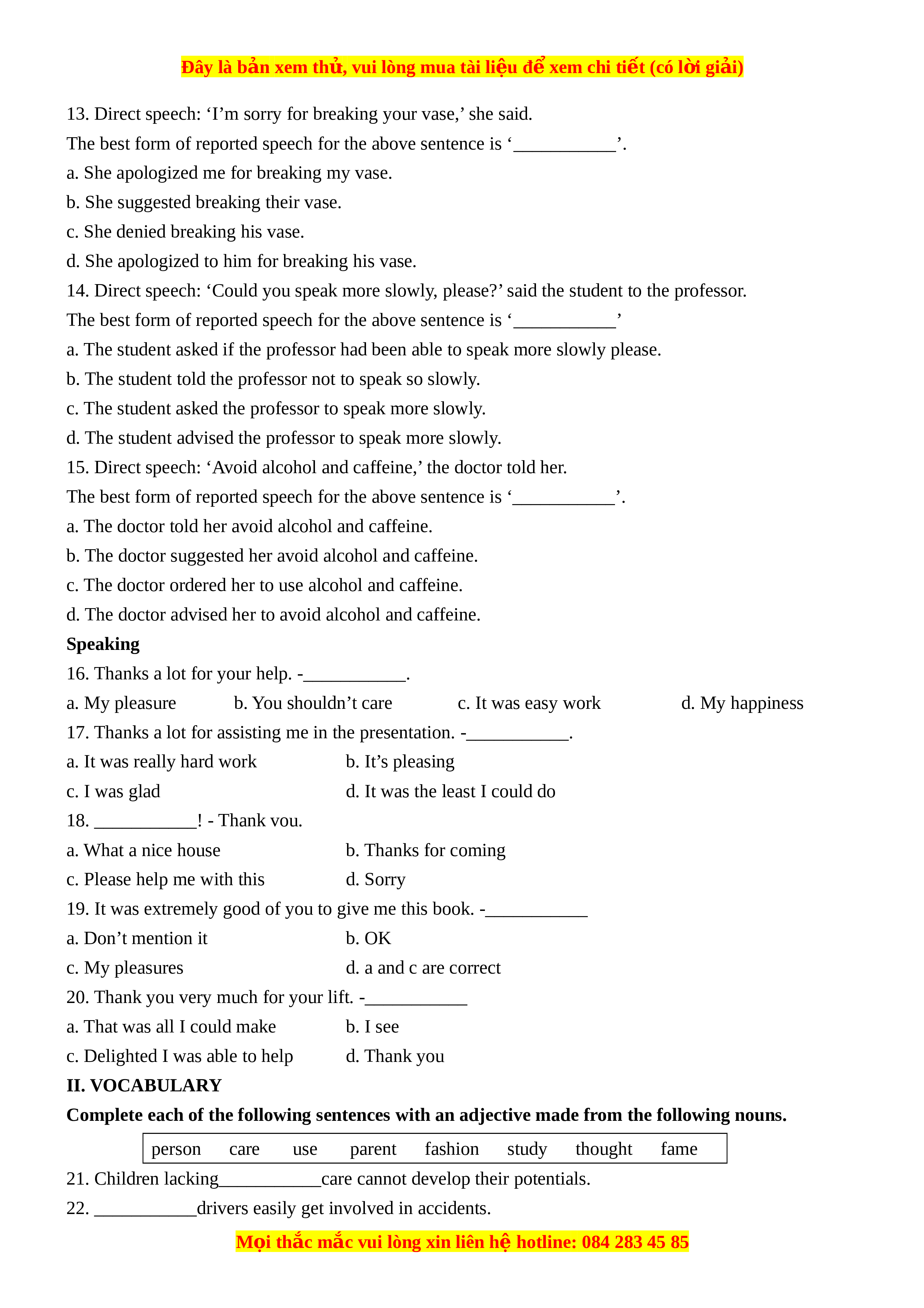
13. Direct speech: ‘I’m sorry for breaking your vase,’ she said.
The best form of reported speech for the above sentence is ‘___________’.
a. She apologized me for breaking my vase.
b. She suggested breaking their vase.
c. She denied breaking his vase.
d. She apologized to him for breaking his vase.
14. Direct speech: ‘Could you speak more slowly, please?’ said the student to the professor.
The best form of reported speech for the above sentence is ‘___________’
a. The student asked if the professor had been able to speak more slowly please.
b. The student told the professor not to speak so slowly.
c. The student asked the professor to speak more slowly.
d. The student advised the professor to speak more slowly.
15. Direct speech: ‘Avoid alcohol and caffeine,’ the doctor told her.
The best form of reported speech for the above sentence is ‘___________’.
a. The doctor told her avoid alcohol and caffeine.
b. The doctor suggested her avoid alcohol and caffeine.
c. The doctor ordered her to use alcohol and caffeine.
d. The doctor advised her to avoid alcohol and caffeine. Speaking
16. Thanks a lot for your help. -___________. a. My pleasure b. You shouldn’t care c. It was easy work d. My happiness
17. Thanks a lot for assisting me in the presentation. -___________. a. It was really hard work b. It’s pleasing c. I was glad d. It was the least I could do 18. ___________! - Thank vou. a. What a nice house b. Thanks for coming c. Please help me with this d. Sorry
19. It was extremely good of you to give me this book. -___________ a. Don’t mention it b. OK c. My pleasures d. a and c are correct
20. Thank you very much for your lift. -___________ a. That was all I could make b. I see
c. Delighted I was able to help d. Thank you II. VOCABULARY
Complete each of the following sentences with an adjective made from the following nouns.
person care use parent fashion study thought fame
21. Children lacking___________care cannot develop their potentials.
22. ___________drivers easily get involved in accidents. M i
ọ thắc mắc vui lòng xin liên hệ hotline: 084 283 45 85
ệ đ xe ể m chi ti t ế (có l i ờ gi i ả )
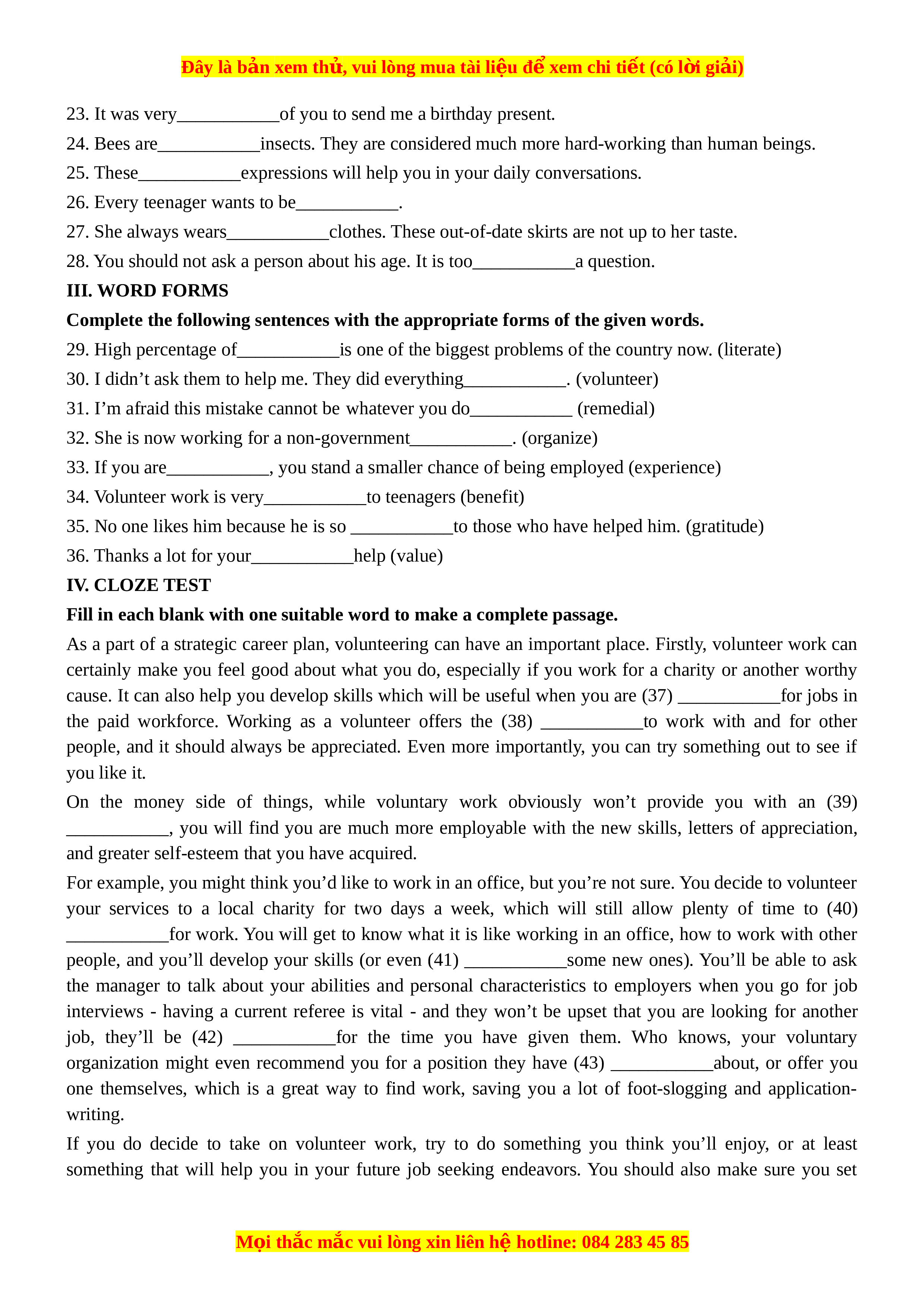
23. It was very___________of you to send me a birthday present.
24. Bees are___________insects. They are considered much more hard-working than human beings.
25. These___________expressions will help you in your daily conversations.
26. Every teenager wants to be___________.
27. She always wears___________clothes. These out-of-date skirts are not up to her taste.
28. You should not ask a person about his age. It is too___________a question. III. WORD FORMS
Complete the following sentences with the appropriate forms of the given words.
29. High percentage of___________is one of the biggest problems of the country now. (literate)
30. I didn’t ask them to help me. They did everything___________. (volunteer)
31. I’m afraid this mistake cannot be whatever you do___________ (remedial)
32. She is now working for a non-government___________. (organize)
33. If you are___________, you stand a smaller chance of being employed (experience)
34. Volunteer work is very___________to teenagers (benefit)
35. No one likes him because he is so ___________to those who have helped him. (gratitude)
36. Thanks a lot for your___________help (value) IV. CLOZE TEST
Fill in each blank with one suitable word to make a complete passage.
As a part of a strategic career plan, volunteering can have an important place. Firstly, volunteer work can
certainly make you feel good about what you do, especially if you work for a charity or another worthy
cause. It can also help you develop skills which will be useful when you are (37) ___________for jobs in
the paid workforce. Working as a volunteer offers the (38) ___________to work with and for other
people, and it should always be appreciated. Even more importantly, you can try something out to see if you like it.
On the money side of things, while voluntary work obviously won’t provide you with an (39)
___________, you will find you are much more employable with the new skills, letters of appreciation,
and greater self-esteem that you have acquired.
For example, you might think you’d like to work in an office, but you’re not sure. You decide to volunteer
your services to a local charity for two days a week, which will still allow plenty of time to (40)
___________for work. You will get to know what it is like working in an office, how to work with other
people, and you’ll develop your skills (or even (41) ___________some new ones). You’ll be able to ask
the manager to talk about your abilities and personal characteristics to employers when you go for job
interviews - having a current referee is vital - and they won’t be upset that you are looking for another
job, they’ll be (42) ___________for the time you have given them. Who knows, your voluntary
organization might even recommend you for a position they have (43) ___________about, or offer you
one themselves, which is a great way to find work, saving you a lot of foot-slogging and application- writing.
If you do decide to take on volunteer work, try to do something you think you’ll enjoy, or at least
something that will help you in your future job seeking endeavors. You should also make sure you set M i
ọ thắc mắc vui lòng xin liên hệ hotline: 084 283 45 85
ệ đ xe ể m chi ti t ế (có l i ờ gi i ả )
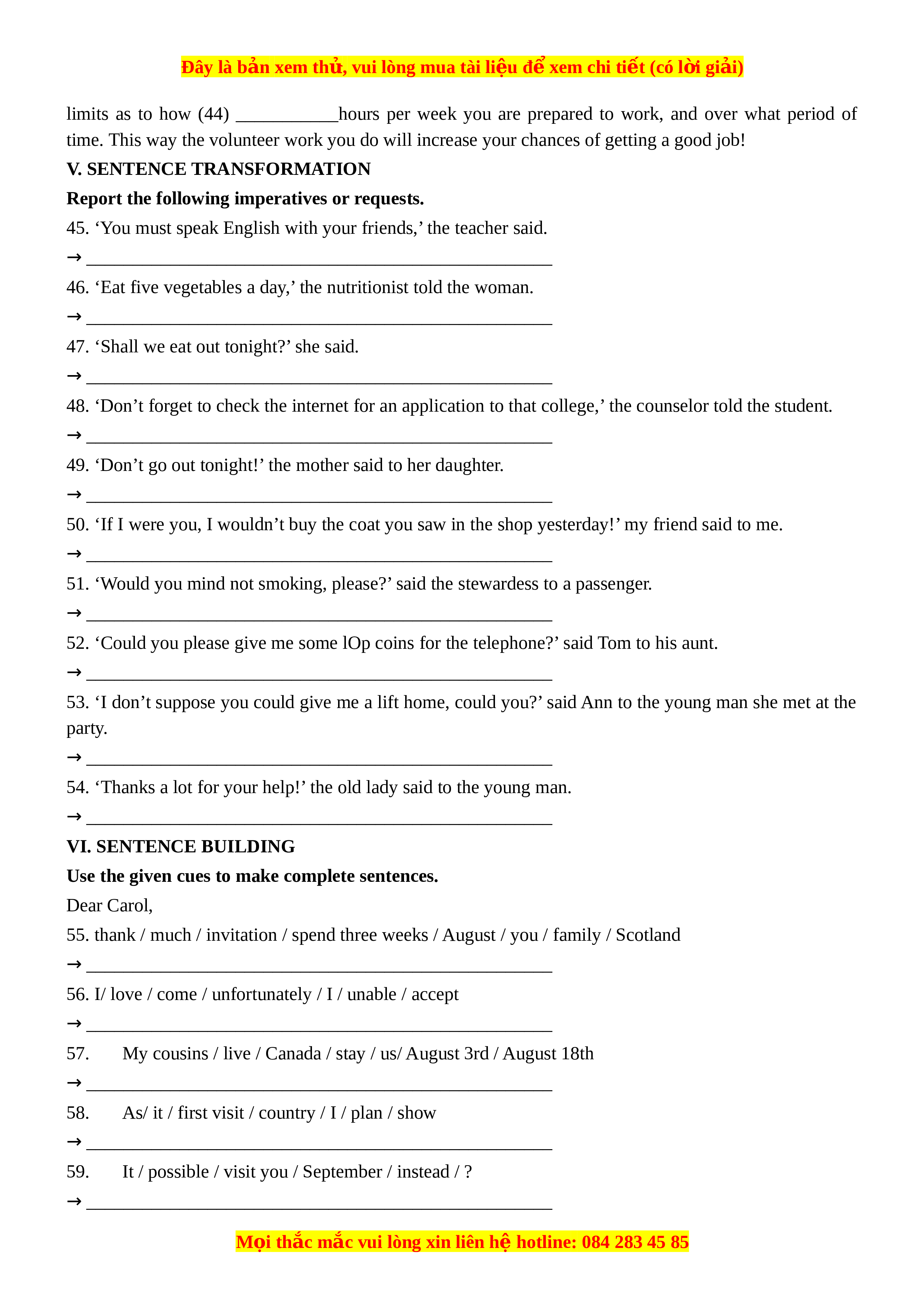
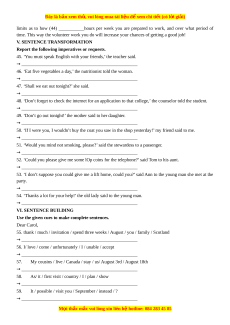
limits as to how (44) ___________hours per week you are prepared to work, and over what period of
time. This way the volunteer work you do will increase your chances of getting a good job! V. SENTENCE TRANSFORMATION
Report the following imperatives or requests.
45. ‘You must speak English with your friends,’ the teacher said.
→ __________________________________________________
46. ‘Eat five vegetables a day,’ the nutritionist told the woman.
→ __________________________________________________
47. ‘Shall we eat out tonight?’ she said.
→ __________________________________________________
48. ‘Don’t forget to check the internet for an application to that college,’ the counselor told the student.
→ __________________________________________________
49. ‘Don’t go out tonight!’ the mother said to her daughter.
→ __________________________________________________
50. ‘If I were you, I wouldn’t buy the coat you saw in the shop yesterday!’ my friend said to me.
→ __________________________________________________
51. ‘Would you mind not smoking, please?’ said the stewardess to a passenger.
→ __________________________________________________
52. ‘Could you please give me some lOp coins for the telephone?’ said Tom to his aunt.
→ __________________________________________________
53. ‘I don’t suppose you could give me a lift home, could you?’ said Ann to the young man she met at the party.
→ __________________________________________________
54. ‘Thanks a lot for your help!’ the old lady said to the young man.
→ __________________________________________________ VI. SENTENCE BUILDING
Use the given cues to make complete sentences. Dear Carol,
55. thank / much / invitation / spend three weeks / August / you / family / Scotland
→ __________________________________________________
56. I/ love / come / unfortunately / I / unable / accept
→ __________________________________________________ 57.
My cousins / live / Canada / stay / us/ August 3rd / August 18th
→ __________________________________________________ 58.
As/ it / first visit / country / I / plan / show
→ __________________________________________________ 59.
It / possible / visit you / September / instead / ?
→ __________________________________________________ M i
ọ thắc mắc vui lòng xin liên hệ hotline: 084 283 45 85
Trắc nghiệm nâng cao Unit 4: Volunteer work and literacy programs Tiếng Anh 11 - Mai Lan Hương
372
186 lượt tải
0 ₫
MUA NGAY ĐỂ XEM TOÀN BỘ TÀI LIỆU
CÁCH MUA:
- B1: Gửi phí vào TK:
1133836868- CT TNHH DAU TU VA DV GD VIETJACK - Ngân hàng MB (QR) - B2: Nhắn tin tới Zalo VietJack Official ( nhấn vào đây ) để xác nhận thanh toán và tải tài liệu - giáo án
Liên hệ ngay Hotline hỗ trợ: 084 283 45 85
Tài liệu được cập nhật liên tục trong gói này từ nay đến hết tháng 6/2023. Chúng tôi đảm bảo đủ số lượng đề đã cam kết hoặc có thể nhiều hơn, tất cả có BẢN WORD, LỜI GIẢI CHI TIẾT và tải về dễ dàng.
Để tải tài liệu gốc về máy bạn click vào nút Tải Xuống ở trên!
Thuộc bộ (mua theo bộ để tiết kiệm hơn):
- Tailieugiaovien.com.vn giới thiệu Bộ bài tập trắc nghiệm nâng cao Tiếng Anh lớp 11 biên soạn bởi GV Mai Lan Hương mới nhất nhằm giúp Giáo viên có thêm tài liệu tham khảo bài tập Tiếng Anh lớp 11.
- File word có lời giải chi tiết 100%.
- Mua trọn bộ sẽ tiết kiệm hơn tải lẻ 50%.
Đánh giá
4.6 / 5(372 )5
4
3
2
1

Trọng Bình
Tài liệu hay
Giúp ích cho tôi rất nhiều
Duy Trần
Tài liệu chuẩn
Rất thích tài liệu bên VJ soạn (bám sát chương trình dạy)
TÀI LIỆU BỘ BÁN CHẠY MÔN Tiếng Anh
Xem thêm-
 Bài giảng Powerpoint Tiếng Anh 11 Global success300.000 ₫ 3.9 K 2 K lượt tải
-
 Giáo án Tiếng Anh 11 Global success (năng lực số)200.000 ₫ - 250.000 ₫ 15.7 K 7.9 K lượt tải
-
Bộ 20 đề thi HSG Tiếng Anh 11 có đáp án300.000 ₫ 618 309 lượt tải
-
Bộ 23 đề thi giữa kì 1 Tiếng Anh 11 Global success có đáp án150.000 ₫ 17.8 K 8.9 K lượt tải
-
Bộ 15 đề thi cuối kì 1 Tiếng Anh 11 Global success có đáp án150.000 ₫ 11.4 K 5.7 K lượt tải
-
Bài tập phát triển kĩ năng Tiếng Anh 11 Global success100.000 ₫ 1.7 K 856 lượt tải
-
Đề cương ôn tập Cuối kì 2 Tiếng Anh 11 Global succes80.000 ₫ 550 275 lượt tải
-
5 Đề khảo soát chất lượng đầu năm 2024-2025 Tiếng Anh 11 có lời giải90.000 ₫ 1.1 K 571 lượt tải
TÀI LIỆU BỘ BÁN CHẠY Lớp 11
Xem thêm-
Bài giảng Powerpoint Lịch sử 11 Kết nối tri thức250.000 ₫ 14.3 K 7.1 K lượt tải
-
Bài giảng Powerpoint Địa lí 11 Kết nối tri thức250.000 ₫ 10.7 K 5.3 K lượt tải
-
Bài giảng Powerpoint KTPL 11 Kết nối tri thức200.000 ₫ 7.7 K 3.9 K lượt tải
-
Giáo án Hoạt động trải nghiệm 11 Kết nối tri thức (năng lực số)200.000 ₫ - 250.000 ₫ 2.3 K 1.1 K lượt tải
-
Bộ 96 đề thi giữa kì 1 Toán 11 Kết nối tri thức Cấu trúc mới150.000 ₫ - 200.000 ₫ 31.3 K 15.7 K lượt tải
-
Bài giảng Powerpoint Ngữ văn 11 Kết nối tri thức350.000 ₫ 9.2 K 4.6 K lượt tải
-
Đề cương ôn tập giữa kì 1 Toán 11 Kết nối tri thức cấu trúc mới80.000 ₫ 2.3 K 1.2 K lượt tải
-
Giáo án Lịch sử 11 Kết nối tri thức (năng lực số)200.000 ₫ - 250.000 ₫ 6.6 K 3.3 K lượt tải
Tài liệu bộ mới nhất

Đây là b nả xem thử, vui lòng mua tài li u đ xem chi ti t (có l i gi i)ệ ể ế ờ ả
UNIT 4: VOLUNTEER WORK AND LITERACY PROGRAMS
TEST 1
I. MULTIPLE CHOICE
Choose the most suitable option to complete the sentence.
Tenses
1. Cuckoos___________nests. They___________the nests of other birds.
a. don’t build / use b. are not building / use
c. don’t build / are using d. are not building / are using
2. Stop! ___________the notice? - I___________it but I can’t read it because I___________my glasses.
a. Aren’t you seeing / see / don’t wear b. Haven’t you seen / saw / won’t wear
c. Don’t you see / see / am not wearing d. Didn’t you see / see / didn’t wear
3. You___________enough lately. That’s why you feel irritable.
a. didn’t eat b. don’t eat c. haven’t eaten d. hadn’t eaten
4. This time next month I___________on a beach.
a. am sitting b. will sit c. will be sitting d. have been eating
5. When I___________here for a month, I will ask for a pay rise.
a. have been b. am c. will be d. had been
Prepositions
6. The students are divided___________groups to discuss the issue.
a. by b. with c. in d. into
7. The teachers will look___________the children when their parents are___________work.
a. for / in b. after / at c. up / on d. at / off
8. After the discussion, they came ___________ an agreement that you would be responsible
___________ interviewing candidates.
a. at / to b. to / for c. into / on d. with / as
9. Our report is based___________our experiments on the animals.
a. on b. by c. into d. as
10. We decided to set___________at 8 am.
a. up b. in c. off d. by
Grammar
11. Direct speech: ‘Take that away!’ he said.
The best form of reported speech for the above sentence is ‘___________’.
a. He said me to take that away. b. He told himself to take that away,
c. He ordered me to take that away. d. He asks me to take that away.
12. Direct speech: ‘Please don’t talk!’ he said.
The best form of reported speech for the above sentence is ‘___________’.
a. He advised me not to talk. b. He asked me not to talk.
c. He insisted me not to talk. d. He wanted us to keep talking.
M iọ th c m c vui lòng xin liên hắ ắ ệ hotline: 084 283 45 85

Đây là b nả xem thử, vui lòng mua tài li u đ xem chi ti t (có l i gi i)ệ ể ế ờ ả
13. Direct speech: ‘I’m sorry for breaking your vase,’ she said.
The best form of reported speech for the above sentence is ‘___________’.
a. She apologized me for breaking my vase.
b. She suggested breaking their vase.
c. She denied breaking his vase.
d. She apologized to him for breaking his vase.
14. Direct speech: ‘Could you speak more slowly, please?’ said the student to the professor.
The best form of reported speech for the above sentence is ‘___________’
a. The student asked if the professor had been able to speak more slowly please.
b. The student told the professor not to speak so slowly.
c. The student asked the professor to speak more slowly.
d. The student advised the professor to speak more slowly.
15. Direct speech: ‘Avoid alcohol and caffeine,’ the doctor told her.
The best form of reported speech for the above sentence is ‘___________’.
a. The doctor told her avoid alcohol and caffeine.
b. The doctor suggested her avoid alcohol and caffeine.
c. The doctor ordered her to use alcohol and caffeine.
d. The doctor advised her to avoid alcohol and caffeine.
Speaking
16. Thanks a lot for your help. -___________.
a. My pleasure b. You shouldn’t care c. It was easy work d. My happiness
17. Thanks a lot for assisting me in the presentation. -___________.
a. It was really hard work b. It’s pleasing
c. I was glad d. It was the least I could do
18. ___________! - Thank vou.
a. What a nice house b. Thanks for coming
c. Please help me with this d. Sorry
19. It was extremely good of you to give me this book. -___________
a. Don’t mention it b. OK
c. My pleasures d. a and c are correct
20. Thank you very much for your lift. -___________
a. That was all I could make b. I see
c. Delighted I was able to help d. Thank you
II. VOCABULARY
Complete each of the following sentences with an adjective made from the following nouns.
person care use parent fashion study thought fame
21. Children lacking___________care cannot develop their potentials.
22. ___________drivers easily get involved in accidents.
M iọ th c m c vui lòng xin liên hắ ắ ệ hotline: 084 283 45 85

Đây là b nả xem thử, vui lòng mua tài li u đ xem chi ti t (có l i gi i)ệ ể ế ờ ả
23. It was very___________of you to send me a birthday present.
24. Bees are___________insects. They are considered much more hard-working than human beings.
25. These___________expressions will help you in your daily conversations.
26. Every teenager wants to be___________.
27. She always wears___________clothes. These out-of-date skirts are not up to her taste.
28. You should not ask a person about his age. It is too___________a question.
III. WORD FORMS
Complete the following sentences with the appropriate forms of the given words.
29. High percentage of___________is one of the biggest problems of the country now. (literate)
30. I didn’t ask them to help me. They did everything___________. (volunteer)
31. I’m afraid this mistake cannot be whatever you do___________ (remedial)
32. She is now working for a non-government___________. (organize)
33. If you are___________, you stand a smaller chance of being employed (experience)
34. Volunteer work is very___________to teenagers (benefit)
35. No one likes him because he is so ___________to those who have helped him. (gratitude)
36. Thanks a lot for your___________help (value)
IV. CLOZE TEST
Fill in each blank with one suitable word to make a complete passage.
As a part of a strategic career plan, volunteering can have an important place. Firstly, volunteer work can
certainly make you feel good about what you do, especially if you work for a charity or another worthy
cause. It can also help you develop skills which will be useful when you are (37) ___________for jobs in
the paid workforce. Working as a volunteer offers the (38) ___________to work with and for other
people, and it should always be appreciated. Even more importantly, you can try something out to see if
you like it.
On the money side of things, while voluntary work obviously won’t provide you with an (39)
___________, you will find you are much more employable with the new skills, letters of appreciation,
and greater self-esteem that you have acquired.
For example, you might think you’d like to work in an office, but you’re not sure. You decide to volunteer
your services to a local charity for two days a week, which will still allow plenty of time to (40)
___________for work. You will get to know what it is like working in an office, how to work with other
people, and you’ll develop your skills (or even (41) ___________some new ones). You’ll be able to ask
the manager to talk about your abilities and personal characteristics to employers when you go for job
interviews - having a current referee is vital - and they won’t be upset that you are looking for another
job, they’ll be (42) ___________for the time you have given them. Who knows, your voluntary
organization might even recommend you for a position they have (43) ___________about, or offer you
one themselves, which is a great way to find work, saving you a lot of foot-slogging and application-
writing.
If you do decide to take on volunteer work, try to do something you think you’ll enjoy, or at least
something that will help you in your future job seeking endeavors. You should also make sure you set
M iọ th c m c vui lòng xin liên hắ ắ ệ hotline: 084 283 45 85

Đây là b nả xem thử, vui lòng mua tài li u đ xem chi ti t (có l i gi i)ệ ể ế ờ ả
limits as to how (44) ___________hours per week you are prepared to work, and over what period of
time. This way the volunteer work you do will increase your chances of getting a good job!
V. SENTENCE TRANSFORMATION
Report the following imperatives or requests.
45. ‘You must speak English with your friends,’ the teacher said.
→ __________________________________________________
46. ‘Eat five vegetables a day,’ the nutritionist told the woman.
→ __________________________________________________
47. ‘Shall we eat out tonight?’ she said.
→ __________________________________________________
48. ‘Don’t forget to check the internet for an application to that college,’ the counselor told the student.
→ __________________________________________________
49. ‘Don’t go out tonight!’ the mother said to her daughter.
→ __________________________________________________
50. ‘If I were you, I wouldn’t buy the coat you saw in the shop yesterday!’ my friend said to me.
→ __________________________________________________
51. ‘Would you mind not smoking, please?’ said the stewardess to a passenger.
→ __________________________________________________
52. ‘Could you please give me some lOp coins for the telephone?’ said Tom to his aunt.
→ __________________________________________________
53. ‘I don’t suppose you could give me a lift home, could you?’ said Ann to the young man she met at the
party.
→ __________________________________________________
54. ‘Thanks a lot for your help!’ the old lady said to the young man.
→ __________________________________________________
VI. SENTENCE BUILDING
Use the given cues to make complete sentences.
Dear Carol,
55. thank / much / invitation / spend three weeks / August / you / family / Scotland
→ __________________________________________________
56. I/ love / come / unfortunately / I / unable / accept
→ __________________________________________________
57. My cousins / live / Canada / stay / us/ August 3rd / August 18th
→ __________________________________________________
58. As/ it / first visit / country / I / plan / show
→ __________________________________________________
59. It / possible / visit you / September / instead / ?
→ __________________________________________________
M iọ th c m c vui lòng xin liên hắ ắ ệ hotline: 084 283 45 85

Đây là b nả xem thử, vui lòng mua tài li u đ xem chi ti t (có l i gi i)ệ ể ế ờ ả
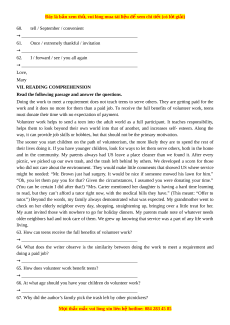
60. tell / September / convenient
→ __________________________________________________
61. Once / extremely thankful / invitation
→ __________________________________________________
62. I / forward / see / you all again
→ __________________________________________________
Love,
Mary
VII. READING COMPREHENSION
Read the following passage and answer the questions.
Doing the work to meet a requirement does not teach teens to serve others. They are getting paid for the
work and it does no more for them than a paid job. To receive the full benefits of volunteer work, teens
must donate their time with no expectation of payment.
Volunteer work helps to send a teen into the adult world as a full participant. It teaches responsibility,
helps them to look beyond their own world into that of another, and increases self- esteem. Along the
way, it can provide job skills or hobbies, but that should not be the primary motivation.
The sooner you start children on the path of volunteerism, the more likely they are to spend the rest of
their lives doing it. If you have younger children, look for ways to let them serve others, both in the home
and in the community. My parents always had US leave a place cleaner than we found it. After every
picnic, we picked up our own trash, and the trash left behind by others. We developed a scorn for those
who did not care about the environment. They would make little comments that showed US where service
might be needed: “Mr. Brown just had surgery. It would be nice if someone mowed his lawn for him.”
“Oh, you let them pay you for that? Given the circumstances, I assumed you were donating your time.”
(You can be certain I did after that!) “Mrs. Carter mentioned her daughter is having a hard time learning
to read, but they can’t afford a tutor right now, with the medical bills they have.” (This meant: “Offer to
tutor.”) Beyond the words, my family always demonstrated what was expected. My grandmother went to
check on her elderly neighbor every day, shopping, straightening up, bringing over a little treat for her.
My aunt invited those with nowhere to go for holiday dinners. My parents made note of whatever needs
older neighbors had and took care of them. We grew up knowing that service was a part of any life worth
living.
63. How can teens receive the full benefits of volunteer work?
→ __________________________________________________
64. What does the writer observe is the similarity between doing the work to meet a requirement and
doing a paid job?
→ __________________________________________________
65. How does volunteer work benefit teens?
→ __________________________________________________
66. At what age should you have your children do volunteer work?
→ __________________________________________________
67. Why did the author’s family pick the trash left by other picnickers?
M iọ th c m c vui lòng xin liên hắ ắ ệ hotline: 084 283 45 85
 Nhắn tin Zalo